
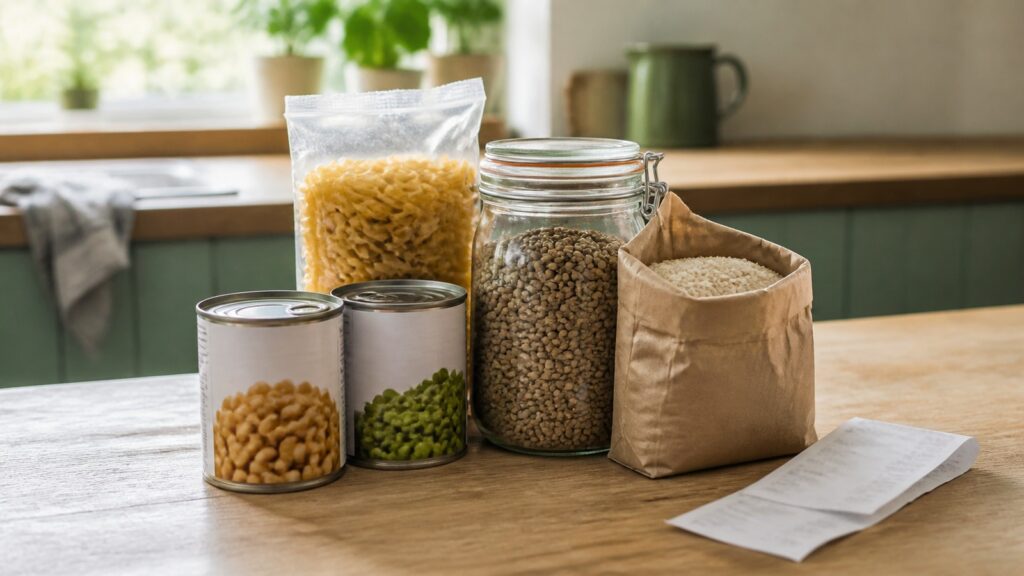
UK shop prices rose faster in August, with food costing 2.8% more than a year earlier. The sharpest acceleration came in cupboard staples such as tinned and packaged food.
The British Retail Consortium and NIQ’s latest figures, released on 1 September 2026, put overall shop price inflation at 1.5%, up from 0.9% in July.
How food prices compare with a year ago
The August figures show different pressures across the shopping basket:
- Food overall: annual inflation rose from 2.2% to 2.8%.
- Tinned and other ambient food: the rate increased from 1.1% to 2.5%.
- Fresh food: inflation eased slightly, from 3.1% to 3.0%.
- Non-food goods: annual inflation increased from 0.2% to 0.9%.
These are year-on-year comparisons. A 2.8% annual food inflation rate does not mean groceries became 2.8% dearer between July and August.
As a simple illustration, a food basket costing £50 a year ago would cost £51.40 if its price rose by exactly 2.8%. That is £1.40 extra for the same basket. Your own change will depend on the products and quantities you buy and the prices you pay.
Fresh food’s lower inflation rate also needs care: prices were still higher than a year earlier. The Office for National Statistics explains that a falling inflation rate can mean prices are rising more slowly, rather than falling.
Higher energy costs are reaching the shelves
BRC chief executive Helen Dickinson attributed the pressure on ambient food to higher energy, input and commodity costs. She also linked rising electrical prices to AI-driven demand for memory chips and storage.
NIQ’s Mike Watkins expects stronger price competition in autumn, although that is a forecast rather than a promise of cheaper shopping.
Compare the unit price on your regular groceries
For shoppers reviewing cupboard essentials, the useful comparison is often the cost per kilogram, litre or 100g, alongside the price of the pack.
The Competition and Markets Authority’s unit-pricing guidance explains how this lets you compare different pack sizes on the same basis. You can usually find the unit price beneath the selling price on a shelf label or in the online listing.
For example, a 500g pack at £1.50 costs £3 per kilogram, while a 750g pack at £2.40 costs £3.20 per kilogram. These are illustrative prices: the bigger pack would cost more for the same quantity.
In its 2024 grocery-pricing research, the CMA found that assumptions about value could be misleading, including the idea that larger packs or promoted products were always cheapest per unit. Check the comparable unit prices before treating a bigger pack or an offer label as a saving.