
Online grocery shopping can save money if it helps you stick to a list, avoid an extra journey and choose a reasonably priced basket. But free delivery does not automatically mean the cheapest shop. Higher food prices, small-order charges and unsuitable replacements can outweigh the saving.
For UK households, the useful comparison is the amount you actually pay for groceries you will use, including getting them home. Here is how the main services compare, when collection or a delivery pass makes sense, and how to keep control of substitutions.
Prices and service information checked on 3 September 2026. Your postcode, chosen slot and final basket determine the charges available to you.
Which supermarket has the cheapest delivery?
There is no single cheapest supermarket delivery option for every order. Ocado advertises some £0 slots, while Iceland offers standard delivery free over £40 but adds a separate picking and packing fee. Sainsbury’s has qualifying slots from £1 and Tesco Flexi saver starts at £1.50. Availability and the rest of the bill decide which is best value.
The table covers ordinary grocery orders, rather than rapid-delivery services or introductory offers. A minimum order is the amount needed to place an order; a small-basket threshold is the amount needed to avoid an extra charge.
| Supermarket | Home-delivery charge to compare | Important spending condition |
|---|---|---|
| Iceland | Standard delivery free over £40; separate picking and packing fee | £25 minimum; free-delivery threshold applies after discounts. |
| Sainsbury’s | £1–£5.50 for next-day onwards slots on orders over £50 | £25 minimum; orders under £50 after relevant discounts carry a £7.50 delivery charge. |
| Tesco | Standard £3–£7; Flexi saver £1.50–£4 | £5 small-basket charge below £50, including with a delivery pass. |
| Waitrose | From £2 | £40 minimum order. |
| Ocado | £0–£9, depending on slot | £40 minimum; spend at least £75 to avoid its small-order charge. |
| Morrisons | Check available slots for your address | £25 minimum; a separate small-order fee can apply below £40, with an exemption for paid Delivery Pass holders. |
| Asda | Check available slots and the complete checkout charge | Orders below £40 can attract a small-basket charge. |
For Iceland, check both the slot charge and the picking and packing fee in its delivery terms and at checkout. Calling the delivery free does not make the entire service fee-free.
Flexible windows can help if you will be home anyway. Sainsbury’s Saver slots, for example, cover four hours or longer before being narrowed on the day. A low price is less useful if the window clashes with work or caring commitments.
Check the final basket after relevant discounts. Do not add £10 of unwanted groceries simply to remove a £5 fee. Adding something you already need for next week may make sense, provided you can store and use it.
When online grocery shopping saves money
Shopping online is cheaper when the savings on the basket, travel and unplanned purchases exceed the extra fees. It can also cost more even with an inexpensive slot, especially if you switch from a cheaper store to a dearer online range.
Compare the whole bill
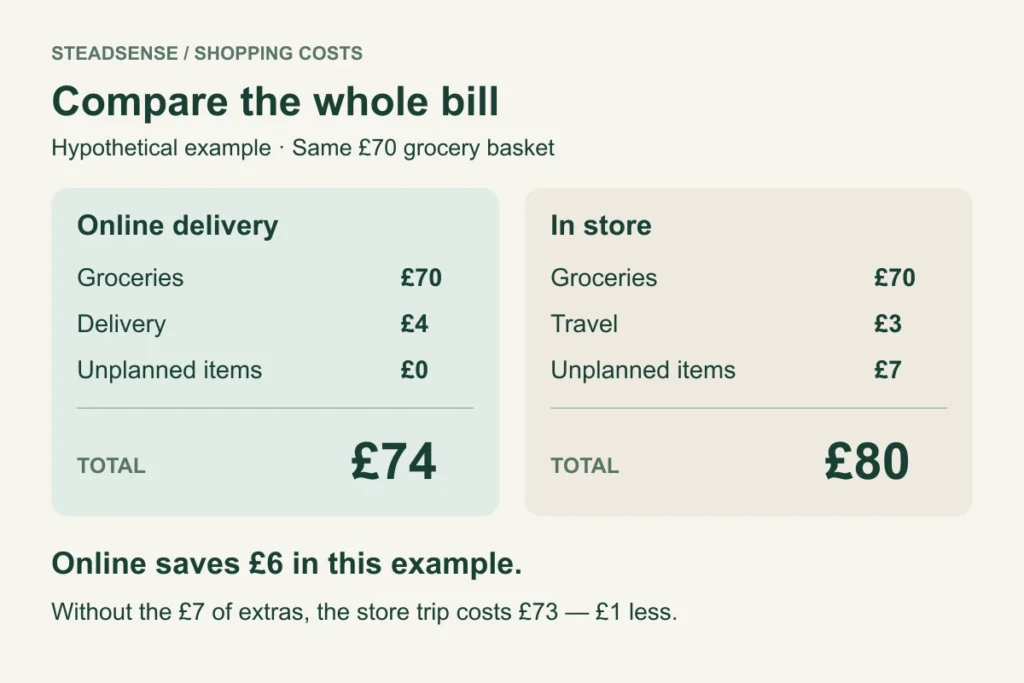
Here is a hypothetical example using the same £70 grocery basket:
| Cost | Online delivery | Shopping in store |
|---|---|---|
| Planned groceries | £70 | £70 |
| Delivery or travel | £4 | £3 |
| Unplanned purchases | £0 | £7 |
| Total | £74 | £80 |
In this example, ordering online saves £6. Remove the unplanned purchases and the store trip costs £73, making online £1 dearer. Neither result is a promise about your own shopping.
Compare matching pack sizes, unit prices and products you would actually buy. A branded basket at one retailer is not a fair comparison with a mainly own-brand basket elsewhere. Our guide to own-brand versus branded food can help you decide where a cheaper alternative suits you.
Treat a first-order voucher as a one-off reduction. Compare the next normal order too, particularly before buying a pass or moving your regular shop.
Use the basket to control impulse spending
Online shopping can reduce impulse spending because you can search from a list, check the running total and remove extras before paying. You can also look in the fridge while deciding whether you need another pack.
It is not automatic. Suggested products, limited-time offers and prompts to reach a spending threshold can create new temptations. Start with meal planning on a budget, then search for the ingredients you need rather than browsing offers first.
Saved favourites are useful, but review them. A product you bought last month may have gone up in price, changed pack size or already be in your cupboard. Before checkout, remove anything you cannot assign to a meal, a household need or a realistic stock-up.
Click and collect or home delivery?
Click and collect is often cheaper in service charges. Waitrose offers free collection with a £40 minimum order. Tesco collection slots range from £0 to £2, with a £5 small-basket charge below £25. Those conditions matter more than the word “free” on its own.
Collection works particularly well if the supermarket is already on your route. If you need a separate return journey, add fuel, parking or public transport costs before comparing it with a delivery slot. Allow for the time spent collecting and carrying the shopping too.
You still rely on the retailer to pick the order, so collection does not remove the need to review substitutions or missing items.
When home delivery earns its fee
Home delivery can be worth paying for when it replaces a costly journey, makes heavy shopping manageable or fits around disability, childcare or caring responsibilities. It does not have to produce the lowest cash total to be useful.
Decide what the convenience is worth within your own budget. If an affordable slot means you can get a full weekly shop without a taxi or an extra trip, that may be a sensible trade. If the shop is a short walk away and you only need a few things, a minimum spend may push you towards buying more than you need.
Check the delivery arrangements for your address, especially if stairs or access restrictions matter. A suitable slot and manageable handover are part of the service you are paying for.
How delivery saver passes work
A delivery saver pass charges a subscription in exchange for eligible deliveries or collections during its term. You still pay for the groceries, and the pass may restrict days, times, order sizes or delivery types. It does not necessarily remove every fee.
Tesco’s 12-month Anytime plan is £6.99 a month, or £83.88 across the term. Its 12-month Off Peak plan is £3.99 a month, or £47.88, for eligible deliveries from 3pm. Tesco’s small-basket charge still applies below the qualifying spend, and Whoosh is excluded. Check the current Delivery Saver plans and eligibility before signing up.
Sainsbury’s lists an £80 annual Anytime Delivery Pass, with a £50 qualifying grocery spend. Compare the commitment and the slots you can actually use, rather than choosing solely by the advertised monthly amount.
Calculate your break-even point
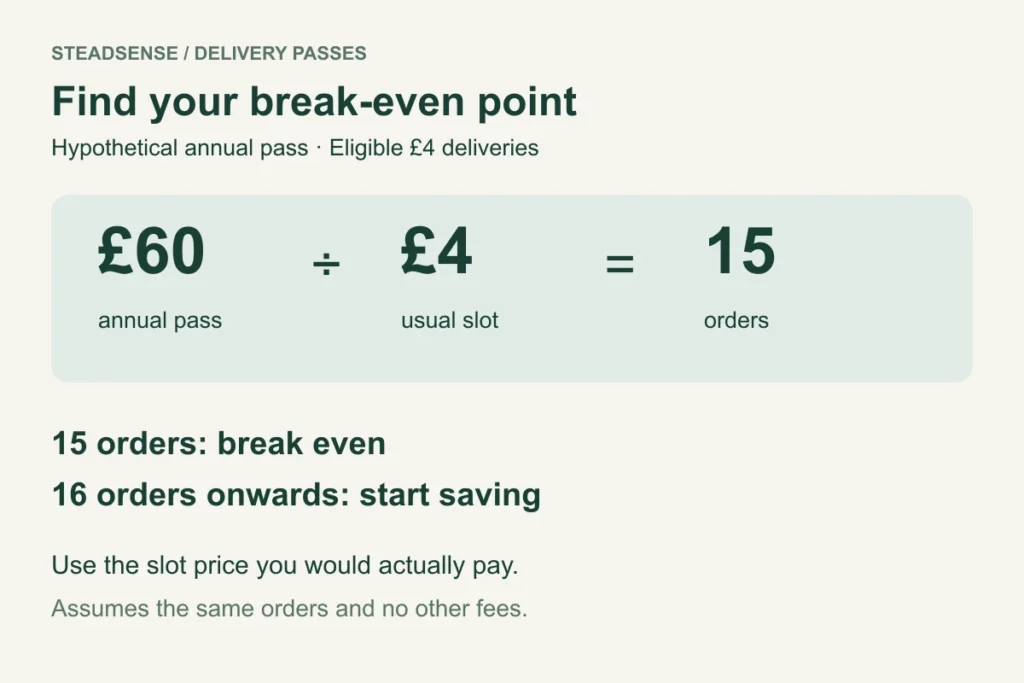
Divide the total pass cost by the delivery charge you would otherwise pay. Use your usual affordable slot, rather than the supermarket’s most expensive one.
For a hypothetical £60 annual pass replacing £4 deliveries, £60 ÷ £4 = 15 orders. You break even at 15 and start saving with the sixteenth eligible delivery.
| Eligible orders in a year | Paying £4 each time | Cost with a £60 pass | Saving after the pass cost |
|---|---|---|---|
| 12 | £48 | £60 | £12 more expensive |
| 15 | £60 | £60 | £0 |
| 26 | £104 | £60 | £44 |
| 52 | £208 | £60 | £148 |
These are illustrative figures, not a current retailer offer. They assume you would place the same orders either way and have no other fees. If your usual delivery is only £1, even 52 orders cost £52, so that £60 pass would leave you £8 worse off.
Before paying, check the full contract length, renewal and cancellation terms, minimum spend, exclusions and seasonal arrangements. Monthly instalments may commit you for longer than a month. Savings guarantees may reimburse the difference with a supermarket voucher rather than cash; Tesco’s uses an eCoupon. A pass also does not guarantee your preferred slot will be available.
Choose a service you can rely on
Tesco and Waitrose jointly led the online customer scores in Which?’s supermarket results published in February 2026, each with 81%. Ocado scored 80%, while Amazon Fresh and Sainsbury’s scored 79%.
The results draw on a November 2025 survey that included 1,417 online grocery shoppers. These are customer scores reflecting satisfaction and willingness to recommend, not percentages of deliveries that arrived correctly. They are a useful starting point, rather than a guarantee about your local service.
For your household, the best online supermarket offers an affordable regular basket, useful slots and an order that arrives as expected. Try a normal order before committing to a subscription. Notice whether:
- The groceries you regularly buy are available in suitable pack sizes.
- Fresh food arrives in usable condition with dates that suit your meals.
- Replacements are sensible and their charges are clear.
- The delivery or collection window works in practice.
- Missing or unsuitable items are straightforward to report.
A service with a slightly higher fee may still be better value if it avoids another shopping trip for missing essentials. Equally, a high survey score does not justify paying more for features you do not need.
Are Ocado and Amazon Fresh worth the cost?
Ocado: compare the basket, not its reputation
Ocado can be expensive compared with mainstream alternatives. In Which?’s August 2026 comparison, its 92-item basket averaged £207.62, against £189.45 at Tesco with a Clubcard and £223.75 at Waitrose. This is a comparison of selected grocery prices, not the complete delivered bill or a prediction for your personal list.
Ocado’s Price Promise compares qualifying like-for-like products with Tesco, including eligible Clubcard prices, and offers a voucher for the difference, capped at £10. It is not a guarantee that everything in your basket, or your delivered total, is cheapest.
Include the slot and any small-order charge in your comparison: Ocado’s £40 order minimum is lower than the £75 spend needed to avoid that extra charge. A free slot can still leave another fee to pay.
Ocado may suit you if its range and delivery arrangements make your regular shop easier. Price your actual repeat basket and compare several normal orders before deciding whether that convenience justifies the difference.
Amazon Fresh: check which service you are using
Amazon Fresh can be worth considering if it serves your postcode, carries what you need and offers a useful slot at a competitive total price. Prime membership is not required for every Amazon grocery order, and availability and fees vary by service. Check the selected store’s checkout rather than assuming ordinary Amazon delivery benefits apply.
Amazon Fresh and supermarket storefronts on Amazon are not one shared grocery basket. Orders from different merchants have separate checkouts, which can mean separate delivery conditions and spending thresholds.
There is also a newer service to distinguish. In June 2026, Amazon launched fresh groceries within its ordinary Same-Day Delivery shopping in parts of central and east London. The launch terms offered free eligible deliveries over £20 for Prime members and a £5.99 charge for non-members. This was a specific service and launch area, not a nationwide Amazon Fresh fee promise. Check your postcode and current checkout for what is available now.
If you already pay for Prime for other reasons, compare the additional cost of your grocery order. If groceries would be your only reason to join, include the membership cost as well. Speed is useful when it solves a real problem; it is less helpful if frequent small orders increase what you spend overall.
Keep substitutions from increasing your bill
An unavailable item does not always mean you pay nothing for it. The supermarket may send a replacement, and the price treatment depends on the retailer. Decide what you would accept before ordering, then check what actually arrives.
Set preferences where the service allows them
Use any available substitution controls to turn replacements off for items where the exact product matters. Where notes or preferred alternatives are supported, specify the important requirement, such as an acceptable pack size. Treat notes as a request, not a guarantee.
Controls vary. Ocado says it will offer substitutes where possible rather than allowing customers to opt out entirely; you can tell the driver which replacements you do not want before accepting them.
Compare the replacement’s quantity and unit price as well as the total. A smaller pack at a similar price may be poorer value, while a larger pack is only useful if you can use or store it.
Know whether you get a price match, a voucher or a higher charge
| Retailer | What to watch for |
|---|---|
| Tesco | Dearer substitutes are generally charged at the original item’s price, but changes to meal deals or multibuys can increase the overall deal price. Review the whole offer, and reject unwanted items at handover. |
| Sainsbury’s | Eligible dearer replacements generate a voucher for the difference. This is not an immediate reduction in the amount paid. The voucher lasts two months, and exclusions apply, including weighed items. |
| Ocado | Accepted replacements are charged at their applicable price. Reject an unwanted substitute with the driver to avoid paying for it. |
A voucher only recovers value if you use it on another order you would have made anyway. Do not count it as cash saved on today’s bill or place an unnecessary order just to use it.
Check the order at handover
Read the substitution notification or receipt and identify anything you want to reject before the driver leaves or you complete collection. Check linked offers as well as individual prices. Keep the receipt or order record so you can follow up on a discrepancy through the retailer’s help service.
For allergies or other strict dietary needs, check the actual product label, ingredients and relevant warnings on every replacement. Do not rely on a similar name, packaging or a note left for the picker. The Food Standards Agency’s allergy guidance explains why label checks matter.
If you refuse an essential ingredient, account for any replacement trip when judging how much the online order saved. A cheap basket that leaves you buying dinner elsewhere may not be cheap overall.
Test your next shop before committing
Start with a list for meals you actually plan to cook. Put comparable products into two available supermarket baskets, choose realistic slots and compare the final totals after fees and discounts.
For the first order, set any available replacement preferences and check the receipt against what arrives. Record the final cost, any extra shopping needed and whether the service saved you a journey or useful time.
After a few normal shops, you will have a better basis for choosing between collection, occasional delivery and a pass. The aim is a service that fits your week and keeps the cost of food you will use under control.