
There is no single correct grocery budget. The right amount is one your household can afford, that covers the food you need and that still works on a messy week—not simply the lowest figure you can tolerate.
Official UK spending data gives you a useful comparison point, but your recent receipts are a better starting point for your own budget. Define what counts as groceries, average several typical weeks, check the result against the rest of your essential spending, then turn it into a weekly amount you can see while you shop.
If you go over, treat the difference as information rather than failure. Perhaps a few top-up shops were missing from the calculation, the month included a stock-up, your household's needs changed or the target was too low. A budget is easier to keep when it measures real life instead of expecting real life to behave perfectly.
How much should you budget for groceries?
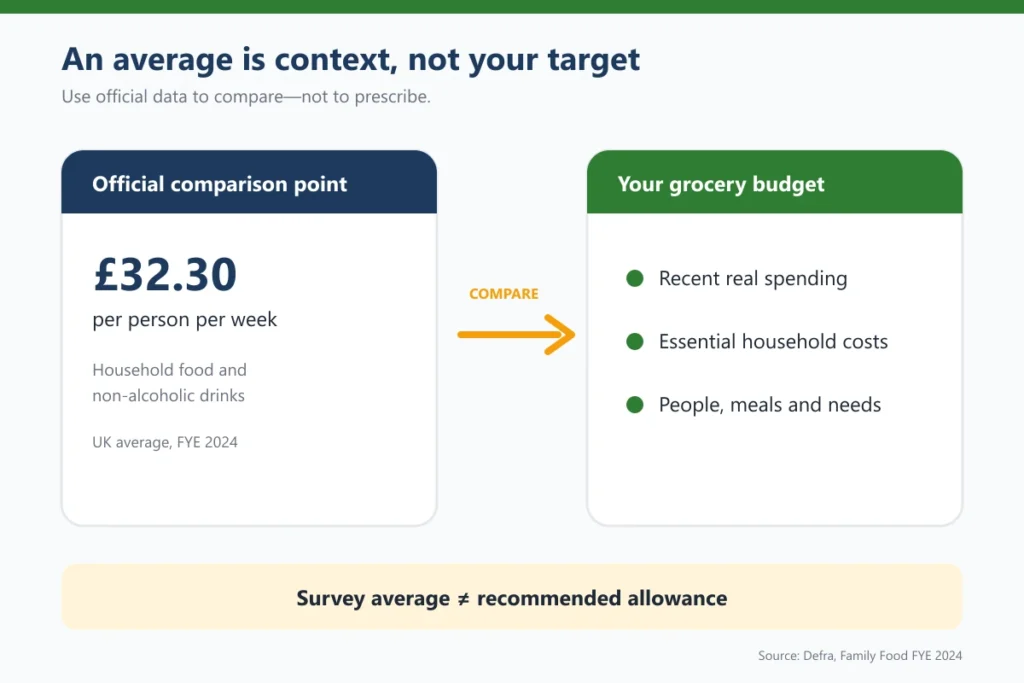
The closest official UK benchmark is £32.30 per person per week. That was the average amount households reported spending on food and non-alcoholic drinks for use at home in the financial year ending 2024. It is equivalent to about £140 per person per month.
This is a comparison point, not a recommended allowance. The data covers April 2023 to March 2024, was collected through household diaries and may understate some purchases. It also excludes alcohol and food or drink consumed away from home. Current shelf prices, your location and the shops you can reach may all differ from the survey period.
You can multiply £32.30 by the number of people in your home to see the rough scale of the national average, but the result is not a reliable family target. Adults and children have different needs, while larger households may share ingredients or buy some products more efficiently. Allergies, prescribed diets, work patterns, appetite, food storage, transport and the number of meals eaten at home all affect the cost.
There is no safe percentage of income that everyone should use, either. In the same official release, household food and non-alcoholic drinks represented 11.3% of spending for the average household and 14.3% for the lowest fifth of households by disposable income. Those figures describe what groups spent; they do not tell you what to spend. A national percentage can be especially unhelpful when essential costs already leave very little room.
A sensible grocery budget passes three tests:
- It fits alongside housing, energy, transport, debt commitments and other essentials.
- It buys enough suitable food for the people and meals you are covering.
- It can be repeated most weeks without relying on skipped meals, debt or an unrealistic amount of time and effort.
Your best first target will usually be close to what a careful version of your own household already costs. You can refine it once you know where the money is going.
Calculate your grocery budget from real spending
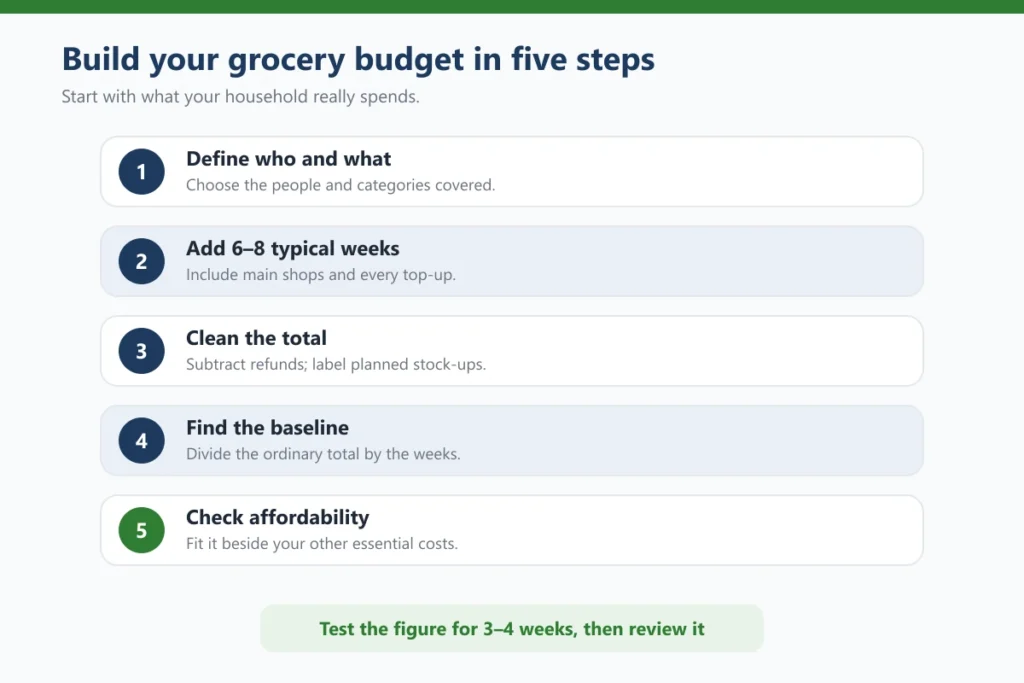
Start with evidence, not somebody else's target. MoneyHelper recommends using bank statements, bills or a banking app to make budget figures realistic and keeping the people covered by the budget consistent. For groceries, six to eight typical weeks is usually long enough to catch main shops and top-ups without turning the exercise into a major project.
Decide what counts
Write one sentence that defines your grocery budget. For example: “Food and non-alcoholic drinks for two adults, including work lunches made at home.” That matches the official household-food category closely enough to make the £32.30 figure a useful comparison.
Supermarket receipts often mix several types of spending. You can give toiletries, cleaning products, pet supplies, alcohol and delivery charges their own lines, while keeping takeaways and eating out separate. If you prefer one combined supermarket budget, that can work too. Keep the boundary consistent and do not compare the combined total with a food-only national figure.
Find your weekly baseline
Gather itemised receipts, order histories and bank transactions for the period you chose. Then:
- Add every main shop and top-up that fits your definition. The quick trip for milk still counts.
- Subtract refunds or cancelled items.
- Label large, planned stock-ups rather than letting them distort an ordinary week.
- Note genuinely unusual weeks, such as hosting several visitors, but do not remove a week simply because it was expensive.
- Divide the remaining total by the number of weeks.
If six weeks of ordinary grocery spending totals £438, the baseline is £73 a week. That is a hypothetical example, not a suggested amount. Its value is in revealing the real starting point, including the little extra shops that are easily forgotten.
For a planned stock-up, either spread the cost across the months in which the food will be used or keep a separate stock-up allowance. Pick one method and stick with it. Counting the whole purchase in one week and then treating later low-spend weeks as “savings” would count the same effect twice.
Check the figure against your wider budget
Put the weekly baseline into your wider household budget. MoneyHelper's Budget Planner adds income and outgoings and shows what is left, which is more useful than deciding on food in isolation.
If the baseline fits, use it as your first test budget or round it to a convenient figure. If it does not, look for named changes instead of imposing an unexplained cut. You might separate cleaning products, reduce a category that is often overbought, change the size of a regular top-up or cap unplanned extras. The aim at this point is to make the target measurable, not to find every possible saving in one go.
Test the figure for three or four weeks. If essential food repeatedly costs more despite deliberate shopping, the evidence may be telling you that the target—not your discipline—is the problem. Recheck the wider budget before cutting food further.
Turn your monthly budget into a weekly allowance
A monthly figure is useful for household planning, but a weekly one is easier to use at the checkout. Convert it with:
Monthly grocery budget × 12 ÷ 52 = average weekly amount
Convert months to weeks using 52 weeks a year
Suppose your monthly grocery budget is £300. The calculation is:
£300 × 12 ÷ 52 = £69.23 a week
The £300 is hypothetical. Dividing it by four would give £75 a week, but spending that for 52 weeks would total £3,900—£300 more than the annual budget. Using 52 weeks also makes a month with five usual shopping days less of a nasty surprise. You can correct small rounding differences when you review the monthly total.
You do not have to spend exactly £69.23 every week. Treat the weekly allowance as a guide for the running balance. One shop might include cooking oil or a large bag of rice; the next may be lower because you use what is already at home. Decide in advance whether unspent money rolls forward for later groceries or returns to the wider household budget.
Set aside a reserve for variable costs
Normal variation is easier to manage when some of the total has a named purpose. You might reserve money for genuine top-ups, a visitor, a price change or a planned stock-up.
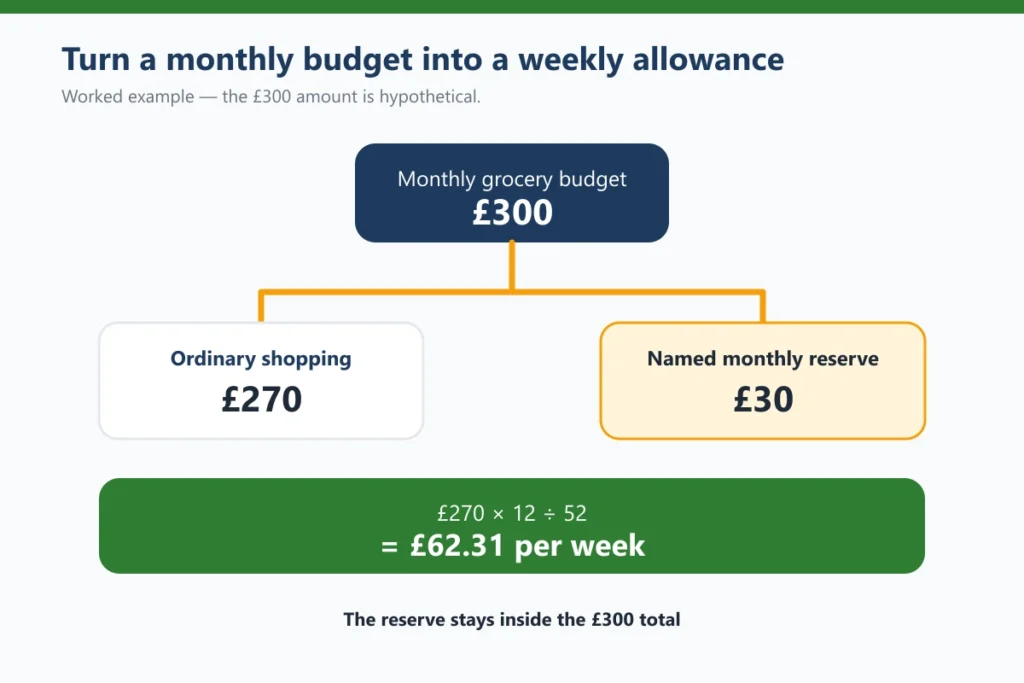
For example, if a household chose to hold £30 of its hypothetical £300 monthly budget in reserve, £270 would remain for ordinary weekly shopping:
£270 × 12 ÷ 52 = £62.31 a week, plus the £30 monthly reserve
The reserve sits inside the £300; it is not extra money. Give it simple rules: record every use, do not dip into it merely because the main shop ran high, and keep the remaining balance visible until the month ends. There is no ideal reserve amount, and a household with predictable shopping may not need one.
You can also set a main-shop rule and a top-up rule. The main shop gets the planned weekly amount, for example, while top-ups must come from whatever remains or from the named reserve. The exact rule matters less than making sure both types of shop appear in the same running total.
Stick to your grocery budget while shopping
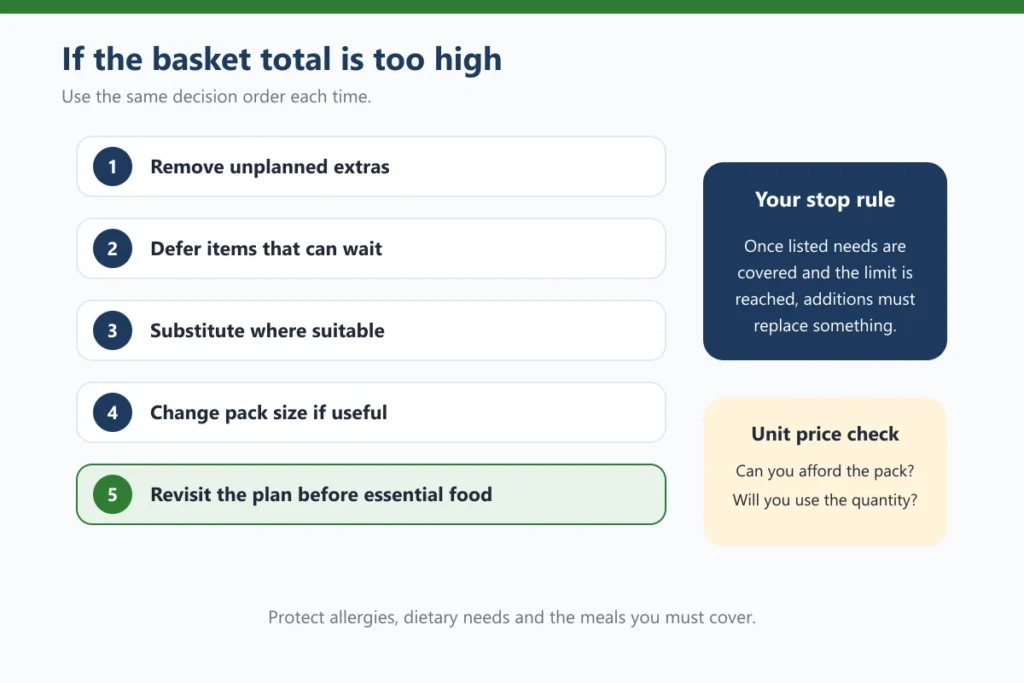
The decisions become easier when you make them in a consistent order. You are not aiming for a perfect meal plan or the cheapest possible basket. You need a shop that covers the week and stays close to the money available.
Before you shop
- Check the fridge, cupboards and any food that needs using soon.
- Look at the coming week. Late shifts, guests, school activities or a low-energy evening change what food will actually be useful.
- Plan the meals and lunches you need, including one realistic fallback meal.
- Put quantities on the list so “fruit” or “yoghurt” does not become more than you can use.
- Set the amount available. If delivery is inside your grocery budget, subtract the charge before filling the basket.
- Keep a planned treat or convenient option if removing it would make the plan harder to follow.
The NHS Eatwell Guide says dietary balance can be considered over a day or week, rather than achieved in every meal. It includes fresh, frozen, tinned and dried fruit and vegetables, while beans, peas and lentils can provide protein and fibre. This gives you room to change formats or ingredients without treating the lowest price as the only goal. Medical diets and allergies still take priority; general budgeting guidance cannot replace individual clinical advice.
While you shop
Keep a running total using the online basket, scan-as-you-shop, a phone calculator or rounded mental arithmetic. Check it before paying, while you can still make calm choices.
If the total is too high, use a pre-decided order:
- Remove items that were not on the list and do not solve a need this week.
- Defer products that can wait until the next budget period.
- Substitute a suitable lower-cost option where taste, allergens and dietary needs allow.
- Change pack size when the smaller total is more useful than the lower unit price.
- Revisit the plan rather than cutting food that is necessary for the meals you must cover.
Unit prices can help you compare similar packs per item, kilogram or litre. Great Britain guidance applying from 6 April 2026 describes them as a tool for comparing price and value; Northern Ireland has separate price-marking legislation. The lower unit price is only better value if you can afford the pack and use the quantity.
Give the shop a stop rule. Once the listed needs are covered and the total reaches the available amount, additions must replace something instead of simply joining the basket. That makes the budget a visible boundary, not a number you discover after checkout.
After you shop
Record the final grocery total, including anything taken from the reserve. Add later top-ups to the same weekly figure. One brief note—“milk ran out”, “guest meal used reserve” or “large pack carried forward”—is enough to improve next weeks plan. Detailed bookkeeping is optional; an honest running balance is not.
What to do if you keep going over budget
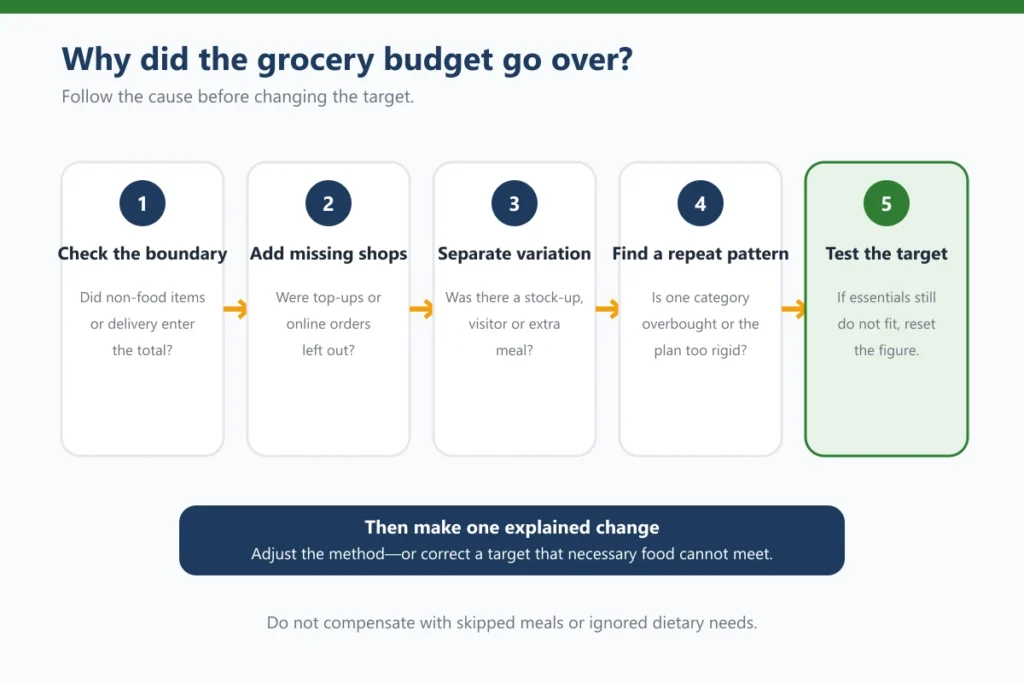
One expensive week does not prove the budget is broken. A pattern over three or four weeks is more useful. Compare the average with the target, then find the reason before changing the number.
Work through this sequence:
- Check the boundary. Did cleaning products, pet supplies, alcohol or delivery charges enter a figure that was meant to cover food only?
- Add the missing shops. Were small top-ups, workplace lunches bought at a supermarket or online orders left out of the plan?
- Separate planned variation. Did the week include a stock-up, visitors or more meals at home? If so, decide which reserve or future period should carry the cost.
- Look for a repeatable change. Is one category regularly overbought, or is a rigid meal plan leading to unused food and a replacement purchase?
- Test the target itself. If the total still represents suitable essential food, the allowance may simply be below the current cost of your household's needs.
Change one lever at a time. You might widen the weekly amount but remove a separate, forgotten top-up; move household products to their own budget; or plan a higher allowance for school holidays. If income varies, start with a cautious whole-household plan and revise it when better months arrive. MoneyHelper advises people with variable income not to budget as though every month will be a good one.
Avoid “paying back” an overspend with a harsh food cut the following week. Food already in the cupboard may reduce the next shop naturally, but skipping meals or setting aside dietary needs to defend an arbitrary number is not a sound correction.
Raise the budget when repeated, checked spending shows that necessary food does not fit. That is not giving up; it is correcting the plan. If the larger figure does not fit alongside other essential costs, review the whole budget rather than hiding the gap in groceries. MoneyHelper provides free, impartial budgeting guidance and routes to further help when spending or debt is causing difficulty.
Keep the final routine small: track every shop, compare the rolling average with the target once a week and make one explained adjustment. A budget you review and reset can keep working. A number you are afraid to change cannot.