

On the latest like-for-like evidence, Nectar saved the most through immediate member prices — but only just. In Which?’s July 2026 comparison, the 93-item shop was £9.99 cheaper with Nectar and £7.18 cheaper with Clubcard. On a much larger branded list in June, Nectar’s member saving beat Clubcard’s by only 44p.
That does not make Nectar the automatic winner, because no two shopping lists are quite the same. It helps to separate three kinds of value: the discount you get today, the rewards you earn for later and the final total at the till. Tesco Clubcard has the stronger fixed points reward: qualifying grocery spend normally returns 1% in Tesco vouchers, and those vouchers can currently be doubled with more than 100 Reward Partners. Nectar’s base Sainsbury’s points return is 0.5%, even though its member prices were more valuable on the two current comparison lists.
It is also possible to spend less without collecting a single point. Aldi has no loyalty scheme and says its lowest prices are not locked behind a card. The best choice therefore depends on what you buy, not the most impressive-looking app.
Which supermarket loyalty card saves the most?
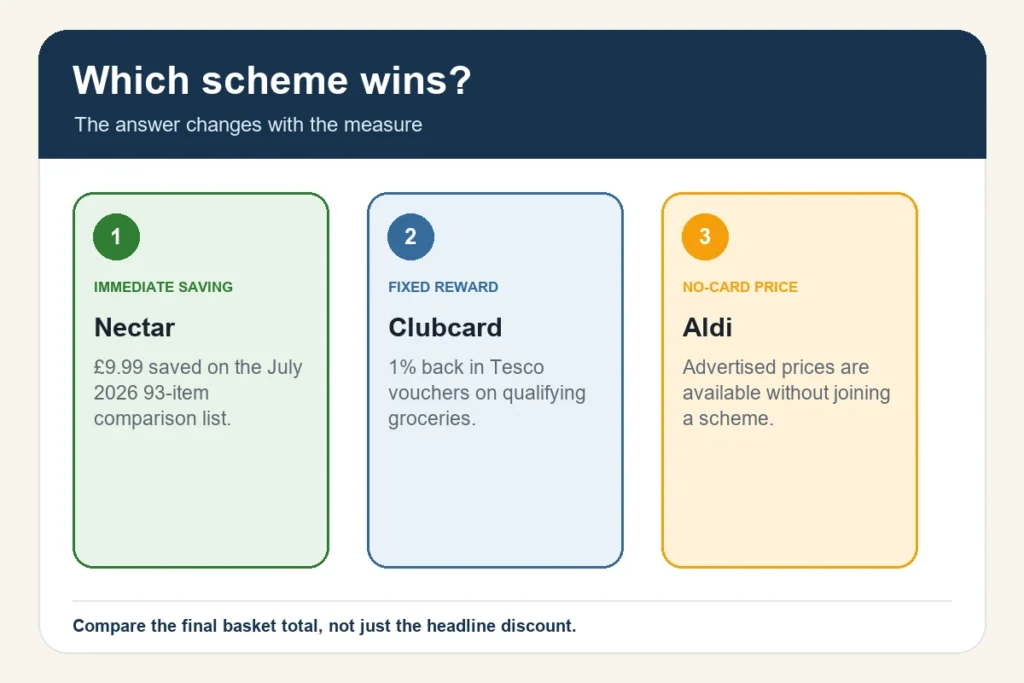
There is no permanent winner because supermarket offers and shopping lists change. The useful comparison is between three separate things:
- Immediate discounts from Clubcard Prices, Nectar Prices and other member pricing.
- Ongoing rewards such as points, Cashpots and vouchers for a later shop.
- The final basket total, which may still be lower at a supermarket without the biggest loyalty discount.
Here is how the main schemes compare as assessed on 9 August 2026:
| Supermarket scheme | Access | Immediate saving | Ongoing reward | Main limitation |
|---|---|---|---|---|
| Tesco Clubcard | Join and scan a card or app | Clubcard Prices and coupons | One point per £1; one point is worth 1p at Tesco, or vouchers can be worth twice as much with eligible Reward Partners | Deals and exclusions change |
| Sainsbury’s Nectar | Join and scan a card or app | Nectar Prices and up to ten personalised weekly prices | One point per £1; 500 points are worth £2.50 at Sainsbury’s | Standard Nectar Prices are not generally available in Locals; personalised prices need unlocking |
| Lidl Plus | App required | Weekly and personalised app offers | One point per £1, exchanged for variable product or money-off coupons | Points have no fixed cash value |
| Morrisons More | Join and scan a card or app | More Card Prices and personalised offers | Five points per qualifying product; 5,000 points become a £5 Fiver | Base return depends on item count, not spend |
| Co-op Membership | £1 | Member Prices | Choose two weekly offers; bonus rewards or credit may also be added | Benefits vary outside Co-op Group stores |
| Asda Rewards | App required | Coupons rather than a broad member-price tier | Missions and eligible activity build a Cashpot for vouchers | No fixed points-per-pound return |
| myWaitrose | Join and scan a card or app | Member savings | Personalised vouchers based on shopping history | Vouchers are not guaranteed every week |
| Aldi | No scheme | Prices and offers are open to everyone | None | No points or personalised loyalty rewards |
The latest independent totals give Nectar the edge for immediate savings. In July 2026, Which? priced 93 branded and own-label items at £187.86 with Nectar and £197.85 without it — a £9.99 difference. Tesco’s same list cost £188.45 with Clubcard and £195.63 without it, saving £7.18. Member prices did most of the heavy lifting; the points earned on either shop would have been much smaller.
The pattern was similar on June’s separate 232-item branded list. Nectar reduced the Sainsbury’s total by £90.79, while Clubcard reduced Tesco’s by £90.35. However, Tesco’s member total was lower: £804.68 with Clubcard, compared with £812.61 at Sainsbury’s with Nectar. In other words, Nectar produced the slightly bigger discount, but Tesco was the cheaper place to buy that particular branded list once both cards were used.
Clubcard produced the biggest same-store single-item discount in that June sample. Listerine Total Care 500ml averaged £6 at Tesco without Clubcard and £2.80 with it — approximately 53% off. That answers which card gave the biggest discount in the sample, not which one will do so next week.
The broader evidence suggests loyalty prices are usually worthwhile. The Competition and Markets Authority examined about 50,000 promotions and found that 92% offered a genuine saving against the retailer’s usual price. The average reduction on loyalty-priced products across the five schemes it examined was 17–25%. It also warned that the member price was not always the cheapest price available elsewhere.
So the short answer is: Nectar produced the biggest member-versus-standard saving on both current comparison lists; Clubcard offered the biggest individual discount in the June branded sample; neither guarantees the lowest overall grocery bill.
Are supermarket loyalty cards worth it?
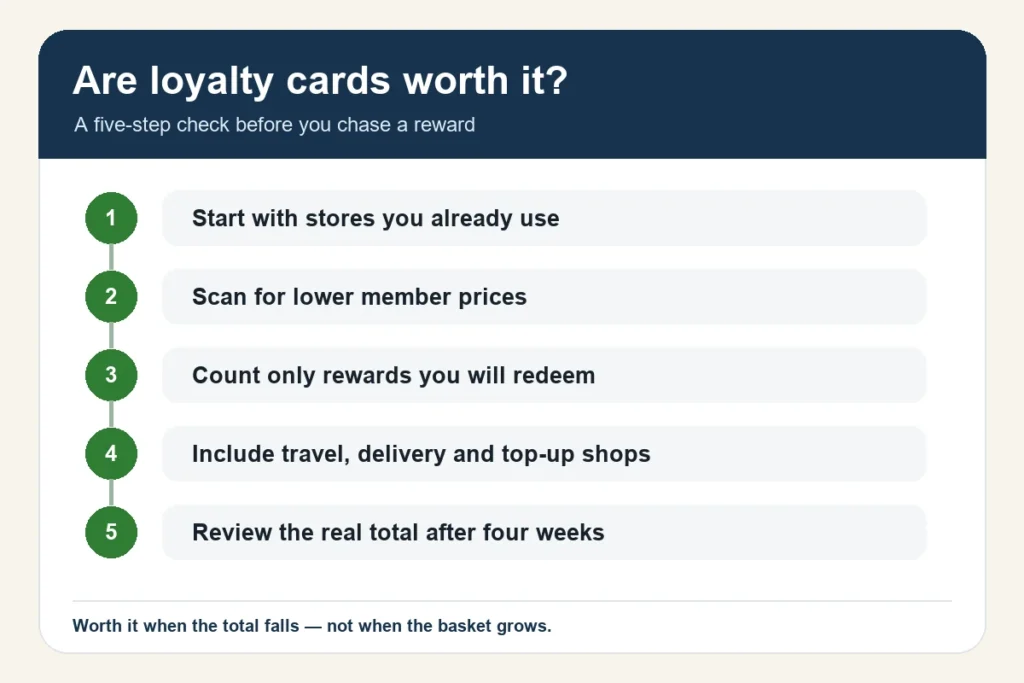
If you already shop at a supermarket, its free loyalty scheme is usually worth using. Scanning a card can unlock an immediate lower price without changing what is in your basket. The base points are a smaller benefit, but they still add up if you remember to redeem them.
Co-op is the exception to the “free to join” rule in this comparison: membership costs £1. It can repay that quickly if a member price or selected weekly offer matches something you planned to buy.
A card is worth having when:
- you regularly shop at that supermarket;
- its member prices apply to things already on your list;
- you will use points or vouchers before they expire; and
- any app-only steps are practical for you.
Where it stops making sense is when the reward changes your habits. Driving farther, making an extra shop or adding an unplanned product can cost more than the points are worth. A crossed-out price is also only a comparison with that retailer’s usual price; another supermarket may charge less without requiring a card.
There is a privacy trade-off too. Loyalty schemes can use purchase history and preferences to personalise offers. The CMA found no evidence of consumer-law concerns in the schemes it reviewed, but it also noted that smartphone and age requirements could make some discounts harder to access. You may reasonably decide that an extra discount is not worth sharing more shopping data.
Can you use more than one loyalty card?
Yes. You can join Tesco Clubcard, Nectar, Lidl Plus, Morrisons More and other schemes at the same time. Use the relevant supermarket’s card when you shop there; joining one does not stop you using another elsewhere.
That is different from trying to scan several loyalty accounts during one purchase. Accounts are generally personal, and individual coupon terms decide whether offers can be combined.
The sensible approach is to keep cards for the supermarkets you genuinely use, rather than treating one chain as your team. Loyalty should work in your favour, not make you ignore a cheaper basket down the road.
How Tesco Clubcard and Nectar work

Clubcard and Nectar both combine member prices with points, but their fixed rewards are not equal. Clubcard gives the higher base return at the supermarket; Nectar offered the larger immediate saving on the current comparison lists.
How Tesco Clubcard works
Under Tesco’s current Clubcard terms, you scan a Clubcard or use the Tesco app at the checkout to receive Clubcard Prices on eligible products and collect points on qualifying spend. Grocery shopping normally earns one point per £1. Each point is worth 1p when converted into Tesco vouchers, so £100 of qualifying spend earns 100 points worth £1 before bonus offers or member-price savings.
Tesco normally converts points into quarterly vouchers once you have at least 250 points. You can request Faster Vouchers in the app or online from 150 points, and unused points below the threshold carry forward. Vouchers are valid for two years.
You can spend the vouchers at face value with Tesco or exchange them for twice their value with more than 100 Reward Partners. That makes Clubcard the strongest fixed-value reward in this comparison: the same £1 earned from £100 of qualifying grocery spend can become £2 with an eligible partner.
The largest savings can still come from Clubcard Prices rather than the points. On June’s branded list, the member-price reduction across the whole basket was more than £90, while the standard points on an £804.68 shop would be worth about £8.04 at Tesco.
Some products and services do not earn points, and Tesco vouchers have spending exclusions. Check the current terms for items such as infant formula, tobacco, lottery tickets, gift cards and alcohol purchases in Northern Ireland.
How Nectar works at Sainsbury’s
Nectar at Sainsbury’s has three layers: points, general Nectar Prices and Your Nectar Prices. Scan a Nectar card or the app in a Sainsbury’s supermarket, or link Nectar to an online grocery account, to receive lower prices on eligible products. Digital members can also unlock up to ten personalised product prices each week.
At Sainsbury’s, qualifying spend earns one Nectar point per £1. Five hundred points are worth £2.50, so £100 of qualifying spend earns 100 points worth 50p before bonus offers or member-price discounts.
That base return is half Clubcard’s Tesco voucher rate. Nectar can nevertheless save more when its immediate discounts match your basket — as it did in the July and June 2026 comparisons.
There are a few practical catches. General Nectar Prices are available in Sainsbury’s supermarkets and online but not generally in Sainsbury’s Local stores. Your Nectar Prices must be unlocked each week and can be used in a Local only where SmartShop is available. Current Nectar Price access is advertised as 18+, and product exclusions apply.
Nectar points can also be collected and spent with participating partners, so their value is not limited to one supermarket. Even so, do not let a bonus-points offer decide the purchase before you have compared the actual price.
How Lidl Plus, Aldi and Morrisons More work
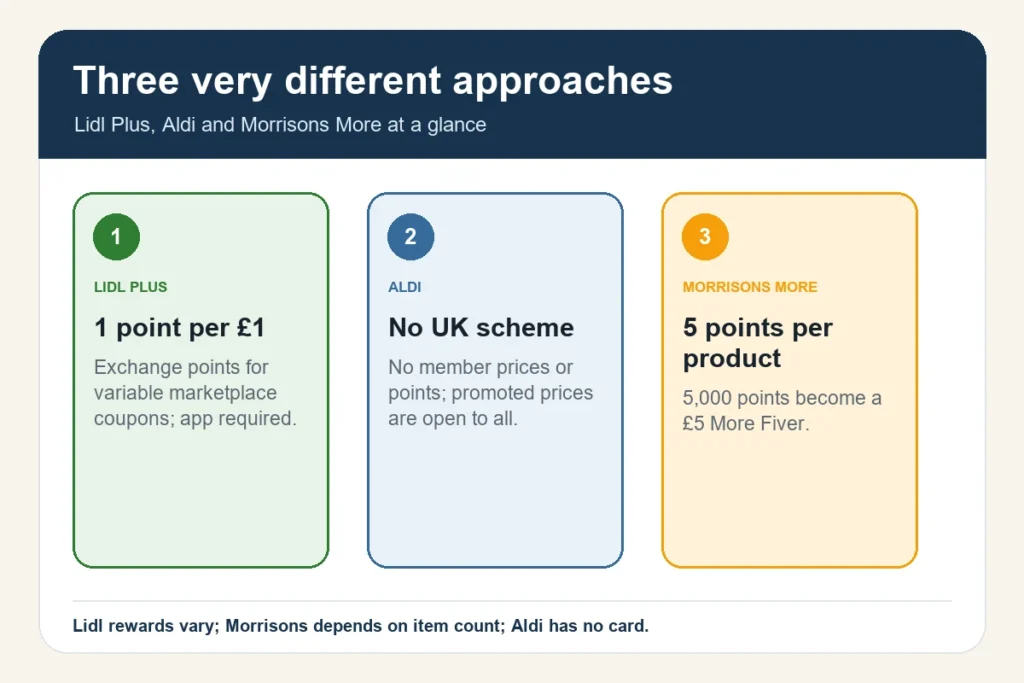
These three supermarkets take very different approaches. Lidl has app points with variable rewards, Aldi has no loyalty scheme, and Morrisons awards points according to the number of qualifying products rather than the amount spent.
How Lidl Plus works
Lidl Plus is an app-based scheme operated in Great Britain. Scan the app before paying to receive weekly or personalised offers and earn Lidl Plus Points. Since 5 May 2026, points have replaced the old Coupon Plus monthly-spend rewards.
You receive one point per £1 spent, rounded up to the nearest pound. The points do not equal a fixed number of pence. Instead, you exchange them in the app’s Rewards Marketplace for product coupons or money-off coupons, then activate the chosen coupon before scanning at the till.
Selected reward coupons normally last 30 days and unused points expire after 24 months. Only the first five Lidl transactions each day earn points, and gift cards, electric-vehicle charging and charitable donations are excluded. The scheme is 18+ and requires a mobile number and email address.
Lidl Plus can be useful if its weekly offers match your shop. However, one point per £1 cannot be compared directly with Clubcard or Nectar because Lidl does not publish a fixed cash value for each point.
How Aldi’s rewards scheme works
Aldi does not have a UK loyalty or rewards scheme. Its app lets you browse groceries and offers, track Specialbuys and create a shopping list, but it does not build points or unlock member prices.
Aldi’s current savings page says it does not lock its lowest prices behind loyalty cards. You therefore receive the advertised price without scanning an account. This is less personalised, but it also means there are no points to track, coupons to activate or rewards to lose.
That can beat a generous-looking scheme in practice. A £10 loyalty saving does not help if the remaining basket is £15 more expensive than the same shop at Aldi.
How Morrisons More points work
Morrisons More members receive five points for each qualifying product when they scan in store or use a linked account online. Points can also be earned through selected Morrisons Daily stores and Groceries on Amazon, with separate fuel earning and points boosters.
At 5,000 points, you can convert the balance into a £5 More Fiver for a later shop. At the base rate, that takes 1,000 qualifying product purchases: 1,000 products × five points = 5,000 points.
The return is therefore not a fixed percentage of spend. Buying a £1 product and a £10 product earns the same base five points if both qualify. Boosters, More Card Prices and personalised offers may be more valuable than the standard points, especially for a household that buys fewer items per shop.
Remember that a More Fiver is a later reward. A More Card Price reduces today’s bill; points only save money after you collect and redeem them.
How Co-op, Asda Rewards and myWaitrose work

Co-op Membership
Co-op Membership costs £1. Scan the physical or digital card to access Member Prices, then choose two personalised offers each week in the Co-op app or online. Current terms also allow bonus offers or member credit to be added to your membership wallet.
Co-op membership points can be confusing because they are not the same as Morrisons or Nectar points. They record qualifying purchases for membership rights, including eligibility to take part in how the Co-op is run. They do not have a cash value and cannot be exchanged as a standard grocery reward.
Your real grocery saving therefore comes from Member Prices, selected weekly offers and any specific bonus reward or credit. The £1 joining cost is modest, but it should still be included when deciding whether the scheme has saved you money.
Co-op Group is not the only co-operative retailer. Independent societies, Nisa stores and some franchise or non-Co-op-branded locations may not provide the same benefits. Southern Co-op also has transition arrangements under the current terms. Check which organisation runs the store rather than assuming every Co-op sign uses one national scheme.
Other variable-reward schemes
Asda Rewards uses Pounds rather than a normal points rate. You complete current missions or other eligible activities to build a Cashpot, then convert the balance into vouchers for a later Asda shop. The value depends on the missions available, so there is no guaranteed percentage back on every grocery bill.
myWaitrose takes another approach. Regularly scanning the card helps Waitrose create personalised vouchers based on your purchase history. Vouchers refresh periodically, may not arrive every week and can have online restrictions, including a £40 grocery minimum for the offer described in Waitrose’s current guidance.
Both can be useful for existing customers. Neither can be ranked fairly against fixed points using a single headline rate because the rewards differ from person to person.
Which supermarket loyalty card is best for you?

Choose the scheme that rewards your normal shopping rather than changing your shopping to serve the scheme.
- Choose Nectar for the strongest current immediate savings evidence. It saved £9.99 on the July 2026 comparison list and narrowly produced the largest member-versus-standard reduction on June’s branded list.
- Choose Clubcard for the clearest fixed ongoing reward. Its base Tesco points are worth 1% in Tesco vouchers and can currently be doubled with eligible Reward Partners.
- Use Lidl Plus when you already shop at Lidl and will check the app. The value sits in matching coupons and marketplace rewards, not a fixed cash rate.
- Use Morrisons More when More Prices, boosters or personalised offers fit your basket. The five-points-per-product base reward is unlikely to be the main saving.
- Use Co-op Membership if member prices and two weekly offers can recover the £1 fee. Check that your store is part of the relevant Co-op scheme.
- Shop at Aldi when you prefer the same promoted prices without joining anything. Aldi has no points, but it can still be cheaper overall.
If the choice is close, run your own four-week test. Price the same repeat basket at the two supermarkets you genuinely use. Record the standard total, immediate member discounts and rewards you actually redeem — not points sitting in an app. Include delivery, travel and any top-up shop.
You can keep more than one card and switch supermarkets when the numbers change. That is the most useful kind of loyalty: loyalty to your budget, not to a barcode — or a folder full of digital coupons.