

Yellow-sticker shopping can cut the cost of fresh food, bakery items and ready meals, but the sticker alone does not make something a bargain. The useful finds are products that replace food you meant to buy and that you can eat, cook or freeze before time runs out.
Reduced food is normally safe to buy when it has been stored correctly, its packaging is sound and it remains within its use-by date. A use-by date is about safety, whereas a best-before date is about quality. That difference matters far more than the colour of the reduction label.
There is no nationwide “magic hour” when every Tesco, Asda or other supermarket makes its final reductions. Timing varies by branch, store format, opening hours, stock and staffing. Evening can bring deeper discounts, but it also brings less choice. The most reliable method is to learn the rhythm of the store you already use, then buy with a plan.
What yellow-sticker reductions mean
A yellow-sticker reduction is a lower price applied to an individual product, usually shown on a new barcode label. Supermarkets may call it “reduced to clear”, a markdown or a “whoopsie”. Aldi often uses red reduction labels, but shoppers still use “yellow sticker” as a general name for this kind of bargain.
Food is commonly reduced because:
- its use-by or best-before date is approaching;
- the outer packaging is imperfect while the sealed product is sound;
- the store has more stock than it expects to sell;
- a seasonal line or product range is ending; or
- bread, hot food or other same-day items are left near the end of trading.
Tesco’s dedicated “Reduced in Price, Just as Nice” areas, for example, contain products such as salads, meat and bread close to their expiry date. Aldi says it reduces fresh produce, bakery and chilled products near the end of their shelf life by up to 75%, and may reduce products with imperfect outer packaging by 30%.
“Up to” is doing important work there. A sticker might take only a few pence off, and the reduced branded item can still cost more than a full-price own-brand alternative. Check the new price, pack size and date rather than assuming every coloured label deserves a place in the trolley.
The label also does not cancel anything on the original packaging. The use-by date, allergens, cooking directions and storage instructions still apply. If the reduction label covers important information, ask a member of staff rather than guessing.
How to find reduced food before everyone else does

Start with the reduced bay, but do not stop there. Some shops gather chilled reductions in one cabinet; others leave the products in their normal locations. Bread may stay in the bakery, meat in the meat aisle and fruit and vegetables in the produce section. Hot counters can have a separate routine again.
Use this simple approach:
- Check the obvious reduced sections. Look for signs such as “Reduced to clear” or Tesco’s “Reduced in Price, Just as Nice”. Tesco says its dedicated areas are now in more than 300 stores.
- Walk the original aisles. Scan the front edge of chilled shelves, bakery displays, produce racks and seasonal ends for coloured stickers.
- Notice the date, not just the discount. Tomorrow’s yoghurt gives you more flexibility than tonight’s salad. The cheaper item is not better if it creates an urgent meal nobody wants.
- Ask politely about the branch routine. Staff may be able to say whether reductions usually happen in the morning, afternoon or near closing. They may not know the exact time, and they do not have to reduce an item on request.
- Keep a three-visit note. Record the day, time, where reduced products appeared and whether the choice was useful. Three ordinary visits tell you more about your local store than a national timetable copied from social media.
Surplus-food schemes offer another route. Participating Morrisons stores sell Too Good To Go Surprise Bags through the app, with a set collection window. Asda has also rolled Too Good To Go out across many supermarkets and Express sites, and Aldi lists a partnership with the service. The contents are a surprise, so these work best if you are flexible rather than trying to fill a precise shopping list.
Lidl also sells “Too Good to Waste” boxes containing fruit and vegetables that are imperfect but good to eat, subject to availability. These are not standard yellow-sticker purchases, but they solve the same problem: edible food needs a home before it becomes waste.
The earlier you arrive, the more choice you may find. The later you arrive, the price may be lower. Aim for the point that suits your household. A modest reduction on chicken you planned to cook tomorrow can be more useful than a near-free tray of pastries bought because the sticker briefly switched off your common sense.
Supermarket reduction times: when to try each store
No major chain in this article promises one fixed UK-wide reduction time. The table combines what retailers told Which? with rough patterns collected by MoneySavingExpert from supermarkets, staff and shoppers. Use the final column as a time to test at your branch, not an appointment with a label printer.
| Supermarket | What the evidence says | A practical time to try |
|---|---|---|
| Tesco | Tesco says products are marked down regularly throughout the day and there is no hard-and-fast rule. Reports describe reductions from early morning, with larger cuts often appearing in the early evening. | Check whenever you normally shop; for deeper cuts, try roughly two to three hours before closing. |
| Asda | Asda says markdowns vary from store to store. Shopper reports collected by MoneySavingExpert place final reductions at about 7pm in some branches, with much of the stock gone by 9pm. | Try around 7pm, then adjust using what you observe locally. |
| Morrisons | Morrisons says reductions are not tied to specific times and may be decided by individual store managers. Shoppers commonly report late-morning or lunchtime reductions. | Look from late morning, and check again in the early evening if the branch uses several rounds. |
| Sainsbury’s | Sainsbury’s did not answer Which?’s latest enquiry. It previously told MoneySavingExpert that discounts are completely store-dependent; shoppers report stock around lunchtime and bigger reductions at about 7pm in some stores. | Try lunchtime for choice or around 7pm for possible later reductions. |
| Lidl | Lidl says reductions tend to happen first thing in the morning and a few hours before closing, although staff can add stickers throughout the day. | Check at opening, or two to three hours before the store closes. |
| Aldi | Which? reports that reductions are likely close to closing. Aldi officially says fresh produce, bakery and chilled products can be reduced by up to 75% near the end of shelf life, but it does not publish a clock time. | Try during the final couple of hours; some shoppers report later reductions from about 8pm where opening hours allow. |
The most accurate answer to “What time does my supermarket reduce food?” is therefore: it depends on the store. A large superstore, a convenience branch and a supermarket that closes early on Sunday may all run different checks. Bank holidays can move work earlier, while low stock may mean there is little to reduce at all.
Charity collections and staff schemes can also affect what reaches customers late in the day. Do not assume that an empty reduced bay means you arrived at the wrong minute; the store may simply have sold, donated or avoided surplus stock.
If you want to map the routine, visit at three sensible points — late morning, late afternoon and a couple of hours before closing — but combine the experiment with trips you already need to make. Driving across town several nights to save £2 on chance finds is not much of a money-saving strategy.
Does shopping at night really save money?
Shopping at night can save money because some stores apply their deepest reduction when there is little selling time left. MoneySavingExpert describes early evening as the period when the largest cuts often begin, while Which? says Aldi reductions are likely near closing and Lidl commonly has a later round a few hours before closing.
The trade-off is selection. By the final reduction, the useful meat, family-sized meals or longer-dated items may already be gone. What remains can be a collection of products that are cheap individually but do not make a meal. A bag containing three desserts and a lonely pot of houmous is technically food; it is not automatically a dinner plan.
Before putting a reduced item in the basket, ask:
- Would I buy something similar anyway? If not, the sticker has created spending rather than reduced it.
- Is it cheaper than a suitable alternative? Compare the unit price with own-brand and smaller packs.
- Can we use all of it? Check the date, portions and who will actually eat it.
- Can I store it safely? Do not buy a freezer bargain if the freezer is full.
- Is the trip itself worthwhile? Count fuel, fares, time and the risk of extra purchases.
Night shopping works best as an add-on to a journey you would make anyway, or for a flexible “use tonight or freeze” slot in the meal plan. It is unreliable for a complete weekly shop. If you need particular ingredients, buy them at a sensible ordinary price rather than gambling dinner on whatever reaches the final bay.
There is also no need to wait for the last possible reduction when an earlier one already gives good value. Paying £2 for the planned main meal at 5pm can be a better result than returning at 8pm to find the shelf empty.
Is reduced food safe?
Reduced food is generally safe when it is still within its use-by date, has been stored at the correct temperature and the pack is intact. The reduction changes the price, not the food-safety rules.
Use-by dates are about safety
A use-by date appears on food that can become unsafe, such as some chilled meat, fish, dairy products and ready-to-eat salads. Official food-labelling guidance says you can eat the food until midnight on the use-by date, but not afterwards unless it was cooked or frozen in time. Do not use smell or appearance to overrule the date; harmful bacteria are not reliably detectable that way.
If a yellow-sticker pack says “use by 24 August”, you need to eat, cook or freeze it by the end of 24 August, while following its storage instructions. A further reduction at 8pm does not create another day.
Best-before dates are about quality
A best-before date tells you when the product is expected to be at its best. Correctly stored food can still be safe after that date, although its taste, texture or appearance may decline. You can use sensory checks for best-before foods, but dispose of anything mouldy, rancid, leaking or otherwise spoiled.
This distinction explains why a dented cereal box and same-day raw chicken need different decisions. The cereal may have a quality date and a sealed inner bag. The chicken has a safety date and strict refrigeration requirements.
Check the pack and the journey home
Before buying, check:
- the use-by or best-before date on the original label;
- whether the seal is intact and the pack is not leaking, swollen or badly damaged;
- that chilled food feels properly cold and frozen food remains solid;
- allergen, storage and cooking instructions;
- whether you can get chilled food home promptly; and
- product-recall notices if you have reason to think an item is affected.
A scratched cardboard sleeve may be harmless. A broken inner seal is not worth the risk, however impressive the discount looks. If the pack is damaged in a way that could affect the food, leave it and tell a member of staff.
Put chilled reductions in the fridge as soon as you get home. Food Standards Agency guidance advises keeping a fridge at 5°C or below. A cool bag is useful when the journey is long or the weather is warm. Keep raw meat and fish separate from ready-to-eat food to reduce cross-contamination.
If someone in the household has a serious allergy, is pregnant, is very young, older or has a weakened immune system, be especially careful about original labels, storage and official food-safety advice. A low price is never a reason to relax the protections that matter to them.
How to freeze and use yellow-sticker food
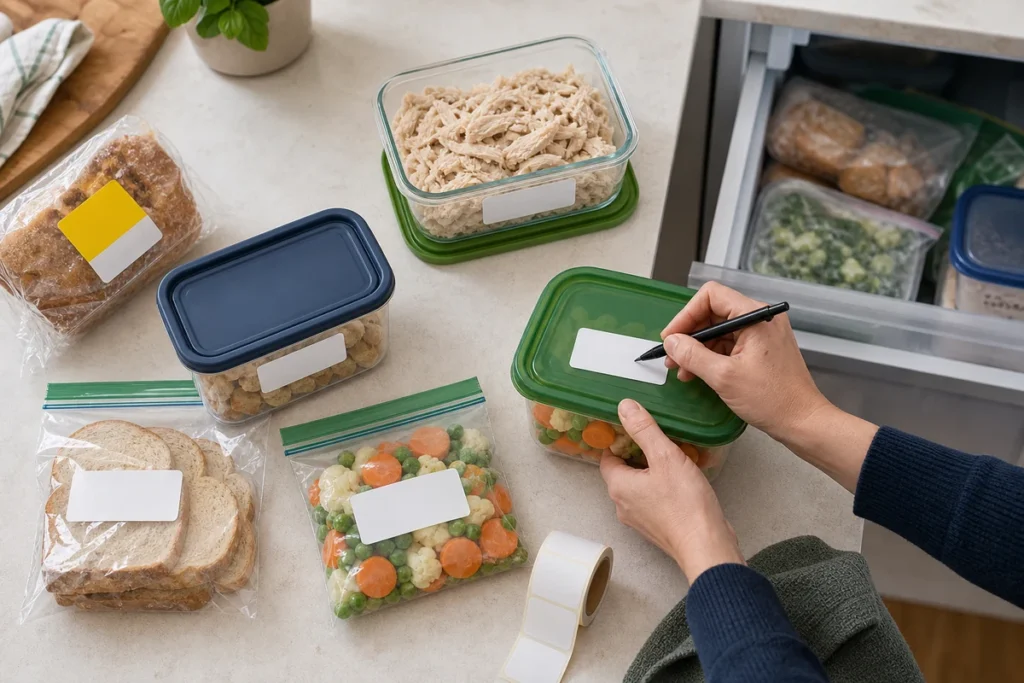
Yes, much reduced food can be frozen. Check the pack first: some products are unsuitable for home freezing, may already have been frozen and defrosted, or have specific instructions.
For food with a use-by date, freeze it no later than midnight on that date. Freezing pauses bacterial growth; it does not make food that has already passed its use-by date safe again. The official chilling, freezing and defrosting guidance says to defrost food in the fridge, then use it within 24 hours and follow the pack’s cooking instructions.
Sainsbury’s yellow-label freezing guidance recommends putting reduced items in the freezer as soon as you get home, dividing them into usable portions and labelling them with the contents and freezing date. That makes the freezer a plan rather than a cold cupboard full of unidentified parcels.
Good candidates often include:
- bread, rolls, cakes and many pastries;
- raw meat and fish when the label allows it;
- grated or portioned cheese;
- milk with room left in the container for expansion;
- many cooked meals and sauces; and
- chopped fruit and vegetables intended for cooking or blending.
Freezing may change texture. Salad leaves, cucumber and high-water fruit can become soft; yoghurt or creamy sauces may separate. They may still have a use in soups, smoothies or cooking, but only buy them if that use suits you.
Give every bargain a job
The simplest reduced-food routine is:
- Decide at the shelf: eat today, cook today or freeze today.
- Check the full price comparison: make sure the reduction beats a suitable alternative.
- Put chilled food away first: keep it at 5°C or below.
- Move eat-first items to one visible fridge box: dates hidden behind jars are dates easily missed.
- Portion and label freezer items: include what they are and when you froze them.
- Plan one use-up meal: build it around the most urgent purchase rather than trying to fit six unrelated bargains into the week.
Yellow-sticker shopping saves money when the food is eaten. Start with the supermarket and time you already use, learn the local pattern and buy only what has a clear route to a plate or freezer. The best reduced haul is not the one with the most stickers; it is the one that quietly lowers the bill without adding waste or risk.