
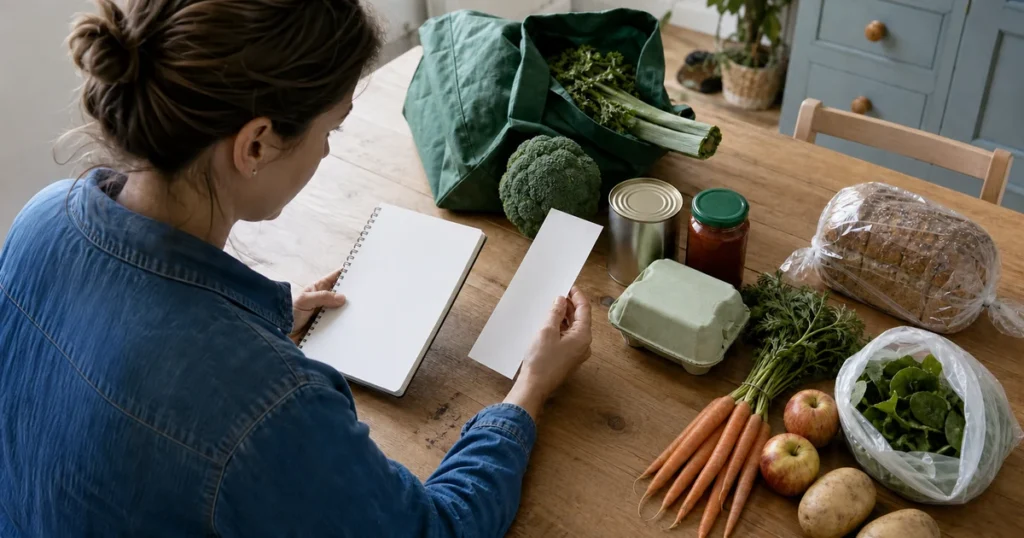
You can spend less on groceries without settling for food you dislike, collecting coupons or cooking every meal from scratch. Most of the useful savings come from three places: controlling what enters the basket, paying a sensible price for the amount you will use, and making sure the food gets eaten.
That does not mean a higher bill is your fault. UK food and non-alcoholic drink prices rose sharply earlier in the decade and were still rising, more slowly, in the 12 months to June 2026. Planning cannot undo national price rises, but it can help you avoid paying for food that does not suit your household.
The most useful grocery budget is not the smallest possible number. It is one that buys suitable food, leaves room for real life and can be repeated next week. The method below works even if you have little storage, limited time or energy, or no interest in visiting several supermarkets.
Why your grocery bill has gone up
Part of the increase is likely to be price inflation. The Office for National Statistics reported that food and non-alcoholic drink prices rose by around 25% between January 2022 and January 2024. The latest ONS figures show that in June 2026, they were 1.7% higher than a year earlier, although they fell by 0.2% over that month.
The distinction matters: a lower inflation rate means prices are rising more slowly. It does not mean the earlier increases have disappeared.
Your personal bill can also change for reasons that a national figure cannot show. A supermarket receipt may include toiletries, cleaning products, alcohol, pet food or delivery fees. Your household may be feeding more people, buying different pack sizes, accommodating a dietary need or using more convenience food during a busy period.
Use two to four recent itemised shops to find the cause. There is no need to justify every purchase. Start by sorting the information.
- Separate food and non-alcoholic drinks from household goods, alcohol, pet products and delivery charges.
- Compare quantities as well as prices. Two packs for £6 cost more today than one pack for £4, even if the price per pack is better.
- Mark new regular items, brand changes and products bought more often.
- Note food that was thrown away, forgotten or replaced by a takeaway.
- Check whether a promotion, loyalty price or usual own-brand product was unavailable.
- Compare unit prices where pack sizes have changed.
This gives you a useful diagnosis. If non-food items caused most of the increase, cutting meal portions will not solve it. If the quantity of food grew because another person is at home, last year’s total is no longer a fair target. If waste or unplanned extras are the problem, you can focus there before changing food quality.
Track a consistent boundary from now on. You might count food and non-alcoholic drinks only, then record toiletries and household supplies separately. The exact categories matter less than using the same ones each time. That turns “the shop feels expensive” into something you can act on.
Plan a grocery shop you can stick to
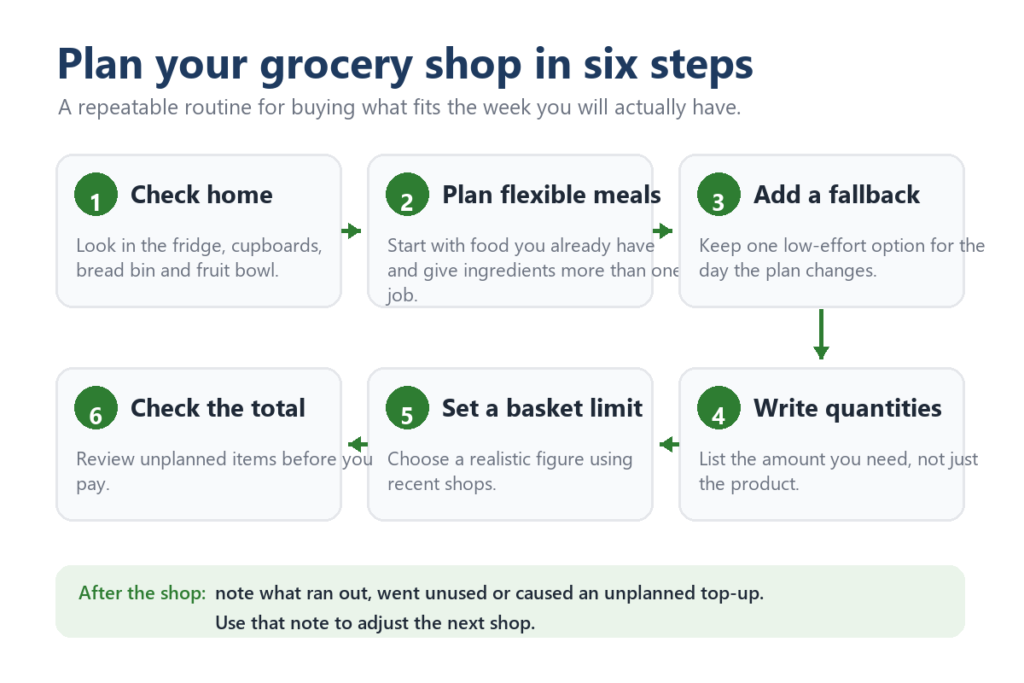
A useful plan starts at home, not in the supermarket. Checking what you already have, making a list and planning when to use leftovers can all help prevent avoidable purchases. No single habit guarantees a particular saving.
Use this sequence before your next main shop:
- Check what needs using. Look through the fridge, cupboards, bread bin and fruit bowl. Put short-life food where you can see it. That half-bag of potatoes and open jar are ingredients, not background scenery.
- Choose flexible meals. Plan enough main meals for the days you are shopping for, but leave room to swap them around. Start with food already at home and give ingredients more than one job. Peppers might go into wraps and a pasta dish; yoghurt might cover breakfast and a sauce.
- Add a fallback meal. Keep one low-effort option for the evening when the planned recipe is not happening. A realistic fallback can prevent both wasted ingredients and an expensive last-minute order.
- Write quantities, not just products. “Apples” is vague. “Four apples” makes it easier to resist a large bag that will not be finished.
- Set a basket limit. Use recent receipts to choose a realistic figure for this shop. If one total feels too blunt, set rough limits for meals, lunches, snacks and household items.
- Check the total before paying. Online, use the running basket total. In a shop, keep a rough total on a phone or calculator, or scan as you shop if that service is available. Put unplanned items to one side and decide at the end.
A shopping list is there to guide the shop, not punish you. Include something enjoyable if the budget allows, and write acceptable alternatives beside items that often vary in price. “Two portions of green vegetables” gives you more flexibility than insisting on one product whatever it costs.
Shopping less often can reduce temptation, but it is not a rule. A large weekly shop may work when you have transport and storage. Smaller shops may be better when you have no freezer, share a fridge or need to carry everything home. Choose the rhythm that produces the least waste and fewest unplanned top-ups.
After shopping, record the grocery total and one short note: what ran out too early, what remained unused and what you bought unexpectedly. After two or three shops, adjust the plan. This small feedback loop is more useful than copying somebody else’s “perfect” weekly budget.
Pay less without buying poor-quality food
Cutting the bill does not require choosing the lowest shelf price every time. Good value combines price, usable quantity, nutrition, taste and suitability. Food is poor value if nobody eats it, it does not meet a dietary need or it creates more work than you can manage.
Compare the usable amount
Use the unit price to compare similar products in different pack sizes. From 6 April 2026, Great Britain’s amended government price-marking guidance describes unit prices per item, kilogram or litre as applicable; Northern Ireland has separate legislation. The unit price may appear beneath the selling price on a shelf label or online.
Then apply the household test: will you actually use the pack?
Suppose 500g costs £2.20, or £4.40 per kilogram, while 1kg costs £3.80. The larger pack is cheaper per kilogram. But if 300g of it goes unused, you have paid £3.80 for 700g you ate—an effective cost of about £5.43 per kilogram. The hypothetical example shows why the biggest pack is not automatically the best buy.
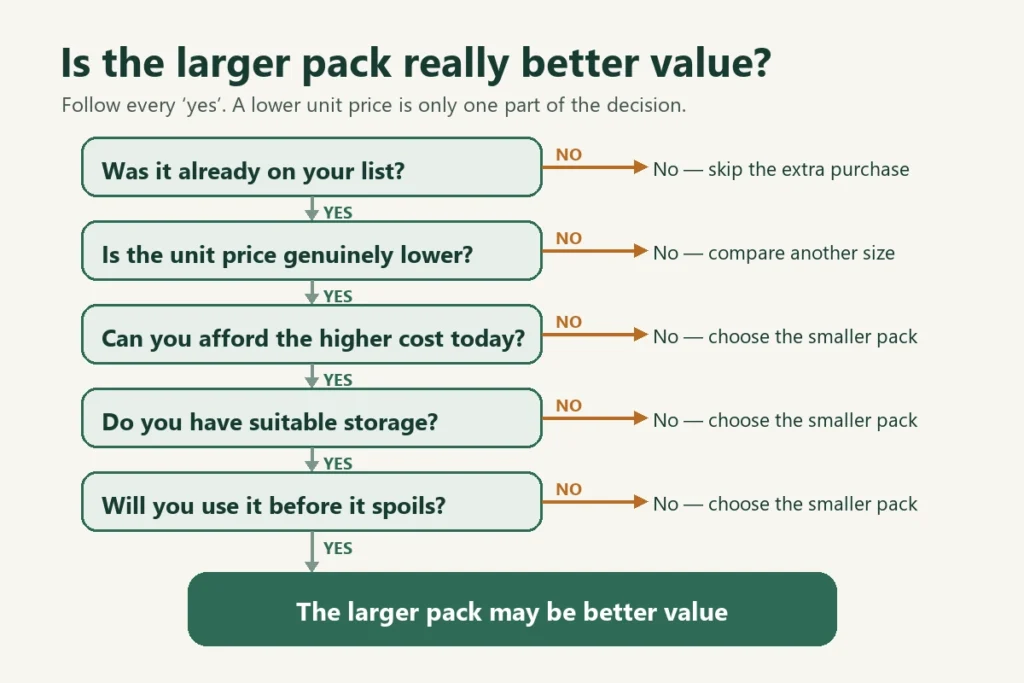
Before buying a larger pack or promotion, check:
- Was the item already on your list?
- Is the unit price genuinely lower?
- Can you afford the higher total today?
- Do you have suitable storage?
- Will you use it before it spoils or passes its use-by date?
If any answer is no, the smaller pack can be better value.
Treat promotions as prices, not instructions
A multi-buy saves money only when it replaces purchases you planned to make. Buying two for £5 instead of one for £3 means spending £2 more today. That may be sensible for a staple you will use, but it is not an automatic £1 saving.
Loyalty prices can be useful, but coupons and memberships are optional. The Competition and Markets Authority found that most loyalty promotions it examined in 2024 gave a genuine reduction against the usual price at that supermarket. It also found examples that were still cheaper elsewhere. Compare the final price and unit price rather than letting the coloured label make the decision.
Switch selectively instead of downgrading everything
Try own-brand or lower-priced alternatives one product at a time. Start where the brand matters least to you: an ingredient mixed into a dish may be an easier test than your favourite coffee. If the alternative works, keep the saving. If it does not, switch back without treating the experiment as a failure.
Check ingredients, allergens and nutrition labels where they matter. The NHS Eatwell Guide includes fresh, frozen, tinned and dried fruit and vegetables, and identifies beans, peas and lentils as sources of protein and fibre. A lower-cost basket can still include a balance of food groups; it does not have to be built from premium-branded products.
Keep paying more where the difference gives you real value—taste that prevents waste, reliable performance in a recipe, an allergen-safe product, better accessibility or a feature your household needs. Save on the items where the difference is mostly packaging, habit or marketing.
The grocery shopping mistakes that cost the most
The most expensive mistakes are rarely one dramatic purchase. They are small leaks repeated every week: food bought without a job, discounts that increase the basket total and plans that collapse by Wednesday.
- Shopping without checking home first. This creates duplicate spices, sauces and cupboard staples while the missing item still gets forgotten. Keep a running list and do a two-minute stock check.
- Buying for an imaginary week. A basket of ambitious recipes is expensive if your real week contains late finishes, caring responsibilities or low-energy days. Match the food to the time and cooking effort you will genuinely have.
- Letting a promotion create a purchase. A deal is useful only if it replaces something planned and the extra quantity will be used. If you take a special offer, reduce other purchases rather than simply adding more to the basket.
- Comparing pack prices instead of unit prices. A £2 pack is not necessarily cheaper than a £3 pack once weight or volume is considered. Compare the same measurement and then choose the usable size.
- Chasing small savings across several shops. A second shop may make sense if it is on your route and the saving is worthwhile. It can backfire when fuel, fares, delivery minimums, time or another round of impulse buying exceed the difference.
- Buying short-life food without a schedule. Put use-by dates into the meal order. The official guidance on use-by and best-before dates explains that use-by dates concern safety, so do not rely on sight or smell after one. Best-before dates concern quality, and correctly stored food may still be usable afterwards if it shows no signs of deterioration.
- Making portions too large by default. Cooking more can create lunch, but only if the leftovers are wanted and stored safely. Cooked food should be cooled and refrigerated within one to two hours, and refrigerated leftovers should normally be eaten within 48 hours or frozen.
- Making the budget too strict. Removing every snack, convenience item and preferred brand can lead to waste or an unplanned takeaway. A sustainable basket is usually cheaper than a perfect plan that lasts three days.
Impulse buys deserve attention, but being hungry in a supermarket is not a character flaw. If shopping hungry makes extra purchases more likely for you, eat first or use collection and delivery when their fees are lower than the usual overspend. Another option is a ten-minute pause: finish the list, review the basket total, then decide which unplanned items still feel worth it.
The useful question is not “Was this item cheap?” It is “Did this spending replace something I needed, and did we use it?” That catches false economies more reliably than any single supermarket trick.
How to save on groceries without a freezer
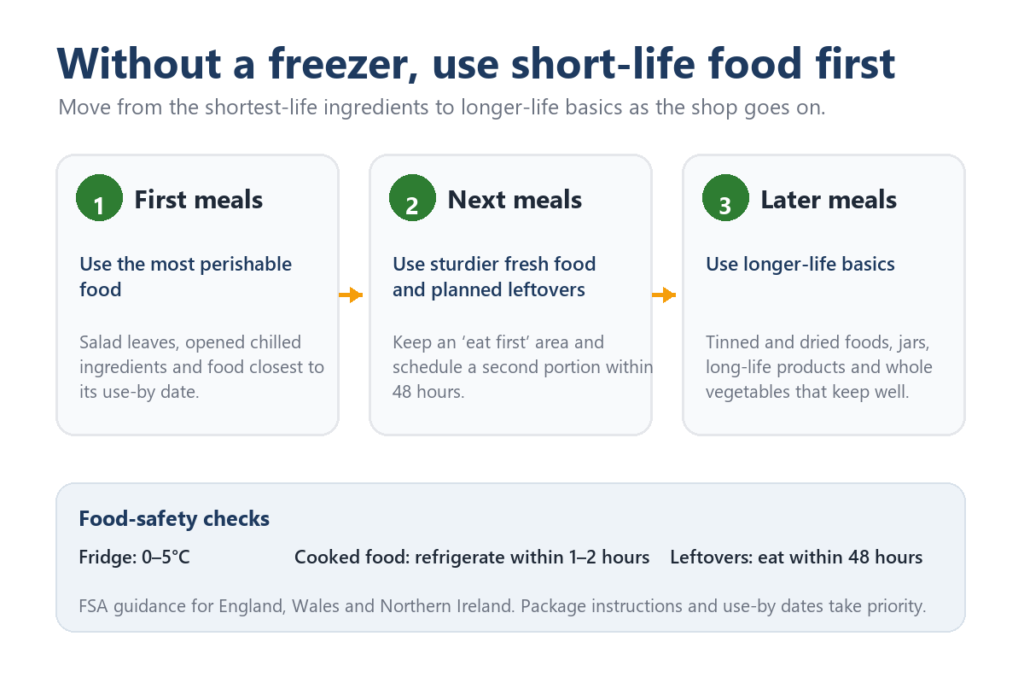
A freezer makes large packs and batch cooking easier, but it is not required. Without one, the plan needs shorter time horizons and more shelf-stable food.
Build meals around a small set of ingredients that store at room temperature or overlap across several meals. Depending on your diet, that might include oats, rice, pasta, bread or wraps, tinned tomatoes, beans or fish, dried lentils, long-life milk, jars and whole vegetables that keep well. The NHS Eatwell Guide confirms that tinned and dried produce can contribute to a balanced diet alongside fresh food.
For short-life food:
- buy the amount needed for the next few days rather than the lowest unit-price pack
- choose loose produce when it lets you buy a useful quantity
- plan the most perishable ingredients first
- keep an “eat first” area in the fridge
- use one ingredient in two meals rather than buying several separate garnishes
- make smaller batches unless the second portion is scheduled within 48 hours
Food Standards Agency guidance for England, Wales and Northern Ireland advises keeping the fridge between 0°C and 5°C, cooling cooked food and refrigerating it within one to two hours, and eating refrigerated leftovers within 48 hours unless they are frozen. Follow the product’s storage instructions and use-by date when either requires earlier use.
A simple pattern is one or two fresh meals followed by meals using longer-life ingredients. For example, salad leaves might be used early, while tinned vegetables and dried staples cover later days. This reduces the pressure to make a large fresh shop last a full week.
Do not pay more overall merely to obtain a lower unit price. With no safe way to store the excess, a smaller pack can be the money-saving choice. Buying exactly what fits your space and schedule is not missing a bargain; it is avoiding waste.
How to spend less when you cannot cook from scratch
“Cook everything from scratch” is common money-saving advice, but it is not realistic for everyone. Time, disability, fatigue, caring work, equipment and confidence all affect what is possible. The cheapest unused ingredients are more expensive than a convenient meal you actually eat.
Think of convenience as a range rather than a choice between raw ingredients and takeaway food. You can combine one prepared component with low-effort foods:
- microwaveable grains with tinned beans and pre-cut or tinned vegetables
- soup with bread, fruit and yoghurt
- eggs with toast and a ready-washed salad
- a ready-made main item with simple vegetables or a starchy side
- tinned fish or pulses in a sandwich, wrap or salad
- porridge, cereal or yoghurt with fruit for a quick meal
These are adaptable ideas, not a promise that every example will be cheapest in every shop. Compare the cost per portion you will use, not the price of an imaginary scratch-cooked version that you do not have the capacity to make.
Choose two or three “assembly meals” that need little more than opening, mixing or heating. Keep one long-life emergency meal so a difficult day does not automatically become an expensive order. If pre-chopped vegetables, grated cheese or microwave rice make the meal happen, their convenience may be worth paying for; compare brands and pack sizes to keep that premium under control.
Quality still matters. Use nutrition labels to compare ready meals and prepared ingredients, paying attention to the features relevant to you. The NHS advises using labels to compare fat, saturated fat, sugar and salt, and looking for balance across the day or week rather than demanding it from every meal.
Also count the hidden waste in cooking ambitions. A recipe that needs six one-off ingredients may cost more than a simple prepared option, even when the per-portion calculation looks attractive on paper. Repeating a few flexible meals, using partly prepared ingredients and buying only the amount needed can reduce the bill without asking you to become a different kind of cook.
If you have allergies, a medical dietary need or difficulty eating, keep the products that work safely for you and seek appropriate professional advice before making major dietary changes.
The easiest ways to save without coupons
Yes, you can reduce your grocery bill without coupons. Apps, vouchers and loyalty prices can trim the cost of a suitable basket, but they are not the foundation. A plan that works at ordinary shelf prices is more reliable.
For your next shop, try this:
- Choose one recent receipt as your starting point and separate groceries from non-food items.
- Check the fridge and cupboards, then plan five flexible meals around what needs using.
- Write one list with quantities and add a realistic fallback meal.
- Compare unit prices for three repeat purchases, while choosing only the amount you can use.
- Test one lower-priced alternative where brand matters least.
- Ignore promotions that do not replace something on the list.
- Record the total and one item that was wasted, ran out or caused an unplanned top-up.
Repeat the process for two or three shops before judging it. Keep changes that save money without making food less suitable. Reverse the ones that create waste, extra work or a takeaway. Then test another small change.
The biggest grocery savings are usually unglamorous: fewer unused purchases, better comparisons and a basket designed for the week you will actually have. That is the encouraging part. You do not need perfect cooking skills, a chest freezer or a folder full of coupons—just a routine you can repeat.