
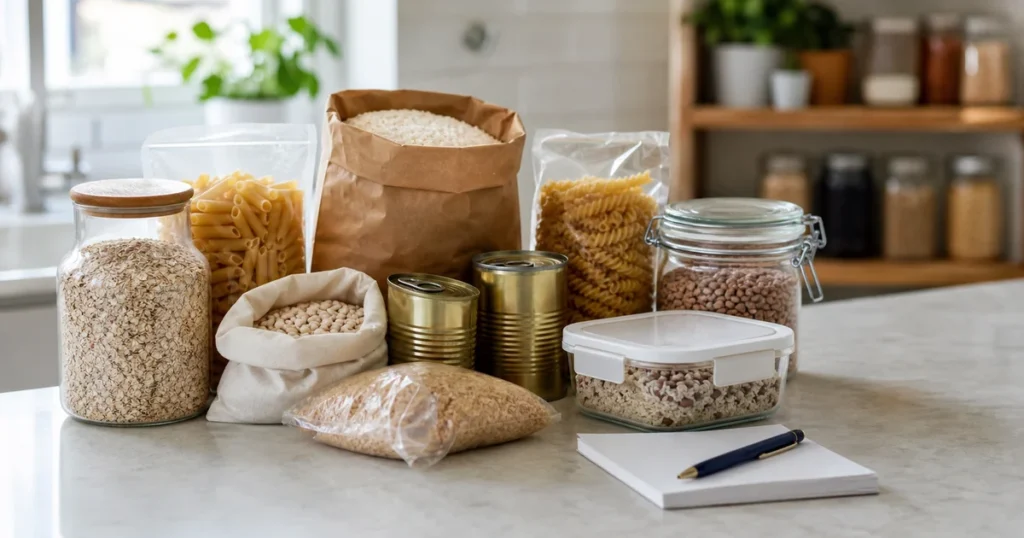
Buying groceries in bulk can be cheaper, but only when the larger pack has a lower unit price and you use it all. A £12 sack of rice is not a saving if half goes stale, attracts pests or sits in a cupboard until you move house.
The useful comparison is not simply small pack versus large pack. It is the cost of the amount you will actually use, plus any membership fee, delivery charge, travel cost and storage you need. Unit prices make the first part easier, but they do not include those extra costs.
That means bulk buying tends to work best for foods your household uses predictably, with enough shelf life and a clear place to store them. It works badly when a low price persuades you to buy more than you need. The same test applies whether the large pack comes from a supermarket, Costco or a trade wholesaler.
Is buying groceries in bulk cheaper?
Sometimes. Start with the shelf's unit price — the cost per kilogram, litre, 100g or item — rather than the pack price. UK government guidance on unit pricing explains that it is designed for comparing different pack sizes and that the largest pack is not necessarily the cheapest per unit.
A supermarket promotion can easily reverse the usual pattern. A standard pack on offer may cost less per 100g than the so-called value pack beside it. Compare the same unit and check that the products are genuinely similar.
Then turn the shelf comparison into a household comparison:
Real cost of bulk purchase = pack price + access and storage costs − value of the amount actually used
You do not need a perfect spreadsheet. Ask four questions:
- Is the unit price genuinely lower?
- How much will we use before quality or safety becomes a problem?
- What will it cost to reach the shop or maintain the membership?
- Does paying more today make the rest of this week's budget harder?
Imagine a 1kg pack costs £3 and a 3kg pack costs £7.50. The larger pack looks better at £2.50 per kg. But if you use only 2kg, your effective cost is £3.75 per used kilogram. The smaller pack would have been cheaper for the food that reached a plate. This is a hypothetical example, but it shows why waste belongs in the calculation.
Bulk buying can still make sense when the headline saving is modest. Fewer shopping trips, reliable stock at home and the ability to portion food for later all have practical value. Just keep those benefits separate from a claim about price.
The upfront cost matters too. Buying six months of staples may reduce their unit cost but leave less money for fresh food, bills or an unexpected expense. If the choice is between a slightly dearer small pack and putting the bulk shop on expensive credit, the smaller pack is likely to be the safer decision.
Foods that usually work well in bulk
The best bulk foods are not necessarily the ones with the longest date. They are the foods you already use often, in fairly predictable quantities, and can store properly.
Good candidates often include:
- Dry staples: rice, pasta, oats, dried pulses and cereals you eat regularly. Choose packs that fit airtight containers and a realistic usage period.
- Tinned foods: tomatoes, beans, pulses, fish and other tins that appear repeatedly in your meals. Check for dents, swelling or damage and rotate older tins to the front.
- Frozen fruit and vegetables: useful when you take out only what you need and have reliable freezer space.
- Meat, fish and prepared foods you can portion promptly: a larger pack can work if you divide, label and freeze it while it is still safe, rather than waiting until the use-by date becomes an emergency.
- Regular packed-lunch or breakfast items: only when the household reliably gets through them and everyone actually likes the product.
Some long-life foods need more caution than their cupboard reputation suggests. Wholegrain flour and brown rice contain more natural oils than refined versions and can lose quality sooner. Nuts, seeds, cooking oils and large tubs of spices can also become stale or rancid before a light user finishes them. A restaurant-sized bottle is not automatically sensible in a two-person household.
Fresh produce is more variable. Potatoes, onions and apples may keep well in suitable conditions, but a large net can still be false economy if your home is warm, damp or short on ventilated storage. Delicate fruit, salad leaves and fresh herbs are usually poor bulk choices unless you have a specific plan to use or preserve them.
The safest starting point is boringly effective: pick the five foods you buy most often, check their unit prices, and test one larger size. Bulk buying is at its best when it supports meals you already make rather than creating a new project called “find a use for 48 tortillas”.
When bulk buying is a bad idea
Bulk buying is poor value when quantity changes your behaviour in a costly way. That might mean eating more because the food is there, getting bored and ordering a takeaway, or throwing away the last third of a pack.
WRAP's 2025 UK household survey found that 80% of respondents bought larger packs for perceived value, while 62% chose smaller packs to suit their household size. It also found that 27% of respondents remained in its high food-waster group. The survey does not show that large packs cause waste, but it does highlight the tension between perceived value and buying the right amount.
A bulk purchase is usually a bad idea when:
- the food has a short use-by date and you do not have a firm meal or freezing plan
- you are trying a flavour, brand or ingredient for the first time
- household plans change often or several meals are eaten away from home
- the pack does not fit your cupboards, fridge or freezer without crowding other food
- the saving depends on buying far more than your normal consumption
- a smaller pack is cheaper per unit because it is on promotion
- the upfront spend puts pressure on the rest of your budget
- you are buying it mainly because the warehouse display makes the quantity look normal
Food waste is not the only loss. A crowded cupboard hides open packs, and an overfilled fridge may struggle to circulate cold air properly. Large quantities can also reduce variety. Ten identical frozen meals may sound wonderfully organised on Sunday and deeply uninspiring by Thursday week three.
Be particularly careful with “just in case” buying. An emergency reserve of a few staples is useful; a year's supply bought without tracking normal use ties up cash and storage. The correct amount is personal. A household of five cooking every day may finish a catering pack comfortably, while one person who travels for work may not.
If you are unsure, buy the next size up rather than the largest available. Record when you open it and when you finish it. That small trial gives you better evidence than a bold saving printed on a shelf card.
How to store bulk food safely

Storage starts before you pay. Check the pack's use-by or best-before date, after-opening instructions and whether you have enough appropriate space. A use-by date is about safety; a best-before date is about quality. The Food Standards Agency's date-label guidance explains why you should follow the pack's storage directions rather than treating every long date as permission to store the food anywhere.
Dry food and tins
Keep dry groceries in a cool, dry cupboard away from direct sunlight and strong smells. Once a large bag is open, transfer food to clean, food-grade containers with tight-fitting lids if the original pack cannot be resealed well. Do not pour a new purchase on top of old food; finish and clean the container first.
Retain the original label or photograph it. You may need the allergen warning, cooking instructions, best-before date or batch details. Label the storage container with the product and date opened. Put older stock at the front so it is used first.
Inspect dry goods occasionally for moisture, mould or pantry pests. A huge pack divided into several sealed containers limits the amount affected if one container develops a problem. Keep tins dry and rotate them; do not use cans that are bulging, leaking or badly damaged.
Chilled food
Keep the fridge at 5°C or below and use a fridge thermometer rather than relying only on the dial. Do not pack it so tightly that cold air cannot circulate.
Keep raw meat and poultry covered, separate from ready-to-eat food and low in the fridge so drips cannot fall onto other items. Large packs should be divided using clean utensils and containers. Work promptly, return the chilled portions to the fridge and freeze any portion you will not use in time.
Once a pack is opened, its “use within” instruction may be more important than the original date. Dividing food does not extend its safe life in the fridge.
Frozen food
Domestic freezers normally operate at about -18°C. Portion food before freezing so you can take out only what you need. Use airtight freezer-safe bags or boxes, remove excess air where practical, and label each portion with its contents, amount and freezing date.
Cool cooked food before it goes into the freezer and divide a large batch into smaller containers so it cools more quickly. Follow the food's pack instructions for freezing and defrosting. Freezing pauses bacterial growth; it does not make food that was already unsafe safe again.
Keep a simple freezer list on your phone or cupboard door. Cross items off when used and plan meals around the oldest stock. The label prevents mystery parcels; the list prevents buying a second mystery parcel because the first one vanished behind the peas.
Is Costco worth it for groceries?
Costco can be worth it if you qualify, live close enough to use it and repeatedly save more than the membership and access costs on products you would have bought anyway. It is not automatically cheaper than a supermarket.
As checked on 27 August 2026, Costco UK's membership page lists Online-only and Gold Star membership at £42 including VAT a year, Business membership at £30, Gold Star Executive at £84 and Business Executive at £78. Warehouse membership is subject to qualification, and the standard Business and Gold Star options include a card for a spouse or partner.
For a standard £42 membership, your planned savings need to exceed £42 plus any extra fuel, parking, delivery or storage cost before the membership saves money. If two cardholders in the same household use it, include both people's planned purchases but not speculative purchases made to “get value” from the fee.
A sensible test is to build a list of 10–15 products you already buy. Compare Costco's current price and pack size with the unit price at the supermarkets you actually use. Include VAT where applicable, and record whether the warehouse version creates more waste. Do this before joining if you can obtain reliable prices, or check Costco's membership terms if you join and discover it does not suit you.
Executive membership adds a 2% reward on most eligible purchases, but the reward has exclusions, caps and timing rules, and is generally calculated on the purchase price excluding VAT. Fuel, food-court purchases and several other categories are excluded. Use Costco's own reward estimate rather than assuming 2% of everything on your receipt.
Costco is more likely to work when you have:
- a repeat list of competitively priced items
- enough dry or frozen storage
- a nearby warehouse or worthwhile online order
- a second household cardholder who uses the membership
- the discipline to skip unfamiliar multipacks and impulse buys
It is less likely to work for a small household with limited storage, a long drive and a preference for fresh food in small quantities. The famous large trolley is not a savings certificate; your before-and-after grocery spending is.
Is Booker worth it?
Booker is not a warehouse club for the general public. Booker's current account guidance says it is trade-only, and applicants need to register and take two proofs of business to a branch. Its online terms say purchases are for resale or use by the business, not for personal consumption.
That makes the first question eligibility, not price. If you are shopping only for your household, Booker is not the alternative to Costco that it can appear to be from the car park. Do not register a business or use someone else's trade card simply to gain personal access.
For an eligible business or charity, Booker may be worthwhile when its pack sizes match genuine operational demand. A café that uses the same tinned tomatoes every day has a very different waste risk from a household that makes pasta sauce twice a month.
Compare:
- the invoice price including VAT where it applies
- the unit price against supermarkets and other suppliers
- the minimum practical quantity
- collection or delivery arrangements
- storage and stock-rotation capacity
- spoilage, breakage and cash tied up in stock
Booker requires customers to sign in to see prices, and online ordering depends on arrangements with the branch. That prevents a useful universal price verdict. Even for an eligible customer, the right answer is product by product: a wholesale pack is valuable when it supports real business demand at a lower total cost, not merely because it is large.
Run a four-week bulk-buying test
Before paying for a warehouse membership or filling a cupboard, test bulk buying on a small group of foods you already purchase. Four weeks is enough to reveal several common problems without committing to a year's supply.
Choose five to ten regular items and record:
| Item | Normal unit price | Bulk unit price | Amount bought | Amount used | Amount wasted | Extra access cost |
|---|---|---|---|---|---|---|
| Example staple | £[amount] | £[amount] | [quantity] | [quantity] | [quantity] | £[amount] |
At the end of the test, count only the food used. Add the relevant share of membership, travel, delivery and storage costs. Note whether the larger quantity changed what you ate or made other food harder to see.
Keep buying an item in bulk when all of these are true:
- its like-for-like unit price is lower
- you use it at a predictable rate
- it can be stored safely without crowding other food
- little or none is wasted
- the upfront cost fits your budget
- you would buy it even without a “bulk” label
Drop back a pack size when one of those conditions fails. You do not have to become a bulk shopper or reject it completely. The most economical basket may contain a large bag of rice, ordinary tins, loose vegetables and a small loaf. Buying the right amount item by item is what saves money.